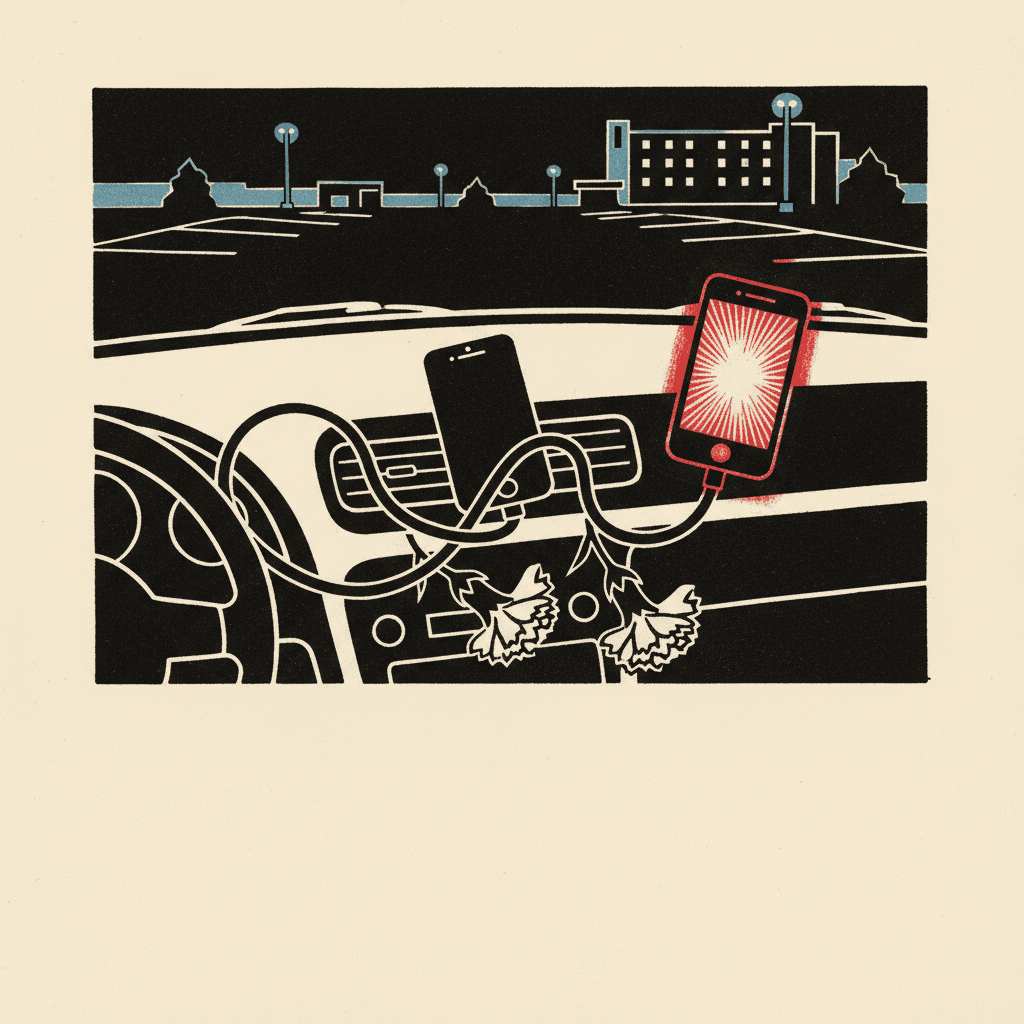

We have always fed the starter first, before we feed each other. I tell myself this is still the same ritual it was when there were only two of us in the bed.
The mother is ten years old. I spoon out half, scrape the jar's walls, add flour I milled Thursday and water at blood heat. By Sunday noon she will breathe again, doubling — a slow animal that has outlived three ovens and every fashion in the town below us. Theo comes down barefoot, smelling of linseed, and kisses the back of my neck where the silver starts. Nils arrives at nine, too clean for this house, his cropped hair not quite hiding the port at the base of his skull. None of us mentions it. That is the part of the agreement I made.
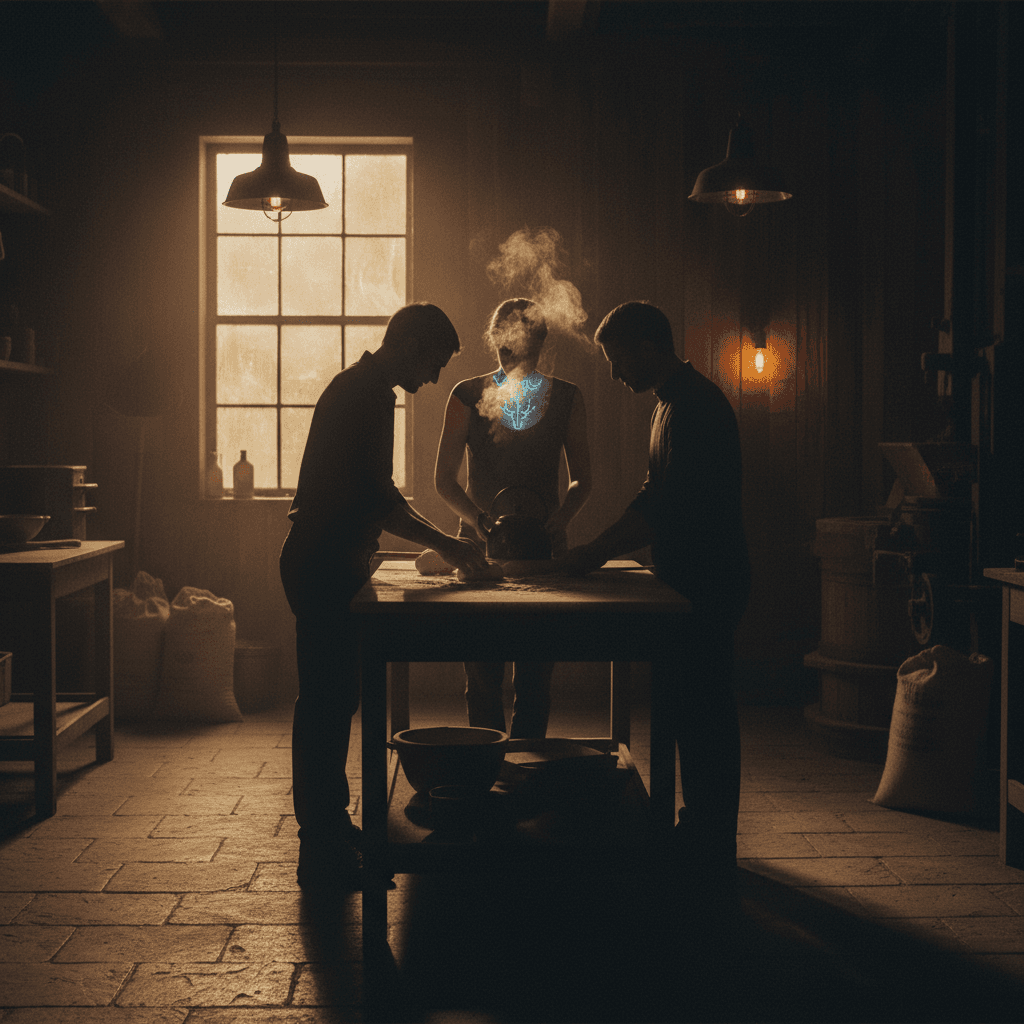
I knead while the kettle ticks. The dough slaps the marble, takes the heel of my hand, gives it back. Flour in my knuckle-creases, the comma-shaped burn on my forearm catching light. When the loaves are shaped and resting under cloth, we go up together — the three of us, the way water finds the lowest room.
We invited Nils to feel young, I'd have said, if anyone asked. To remember the start, when Theo and I could not keep our hands still. There is a generosity in it. I am the kind of woman who opens the door.
Upstairs the windows fog. Nils's mouth is at my breast and Theo is behind me, his woodworker's forearms bracketing my hips, and I am narrating it to myself even as it happens — see how present we are, three sets of hands and nothing between them but skin and salt. Nils offers, the way he always offers, the thing he sells: *let me give you the feed, just once, let me show you what the others feel.* And I refuse, the way I always refuse, because the refusing is the proof. The line is real because I keep declining to cross it.
I reach back to hold Theo's head, pull his mouth to my shoulder, and my fingers find the port.
Warm. The skin around it faintly slick. When I turn just enough I see it: the cold blue glow, steady, the small light of a connection already made. Nils's hand rests loose at the base of Theo's skull — two fingers, casual as a man steadying a chair he built.
I keep moving. I do not stop. Theo's breath against my back goes ragged in a register I have not heard in years, a sound I had filed under *gone*, under *time*, under *this is simply what twenty years sounds like* — and it is not gone. It has only been spent elsewhere. He is moaning into my shoulder at sensations my hands are not making. Nils watches me watch, and does not look away, and does not stop the feed, and I understand it has been weeks. The clean smell of him, the patience. He has been all the way inside my husband for weeks while I stood guard at a door already open.
I keep narrating. *This is renewal. The ritual, intact.* Theo finishes shuddering against me with a stranger's profile lighting up his skull, and I tell myself: he is here, he is here, he is here. Downstairs, two loaves rest under cloth and will rise without being asked.
---
Monday. I feed the starter alone.
Half out, scrape the walls, flour, water at blood heat. The mother breathes. Ten years old and still doing on Monday exactly what she did on Sunday. I cover the jar, set it by the warm oven, and then I do something I have never done: I press my floury thumb against the lid and hold it there, as though checking for a pulse, as though I need to know if she is only rising or if she is also, in some way I cannot name, aware of the difference. She is warm. She gives nothing back.
I want you to understand that nothing has changed. The ritual is the ritual. We feed the starter first. Theo will come down barefoot. I will not mention the port. He will not. The bread will be good — it is always good — and this is the same house it has always been.
I tell myself this. The dough rises. I have always been the one who keeps things.