
She told me the worst part wasn't that he'd already filed the report — it was that he'd filed it beautifully, and she wanted to see it.
This is thirdhand, understand. Marta told me over the good wine, the one she saves, and she is a person who improves a story the way you'd salt something. So take the specifics as gesture. But the shape of it I believe.
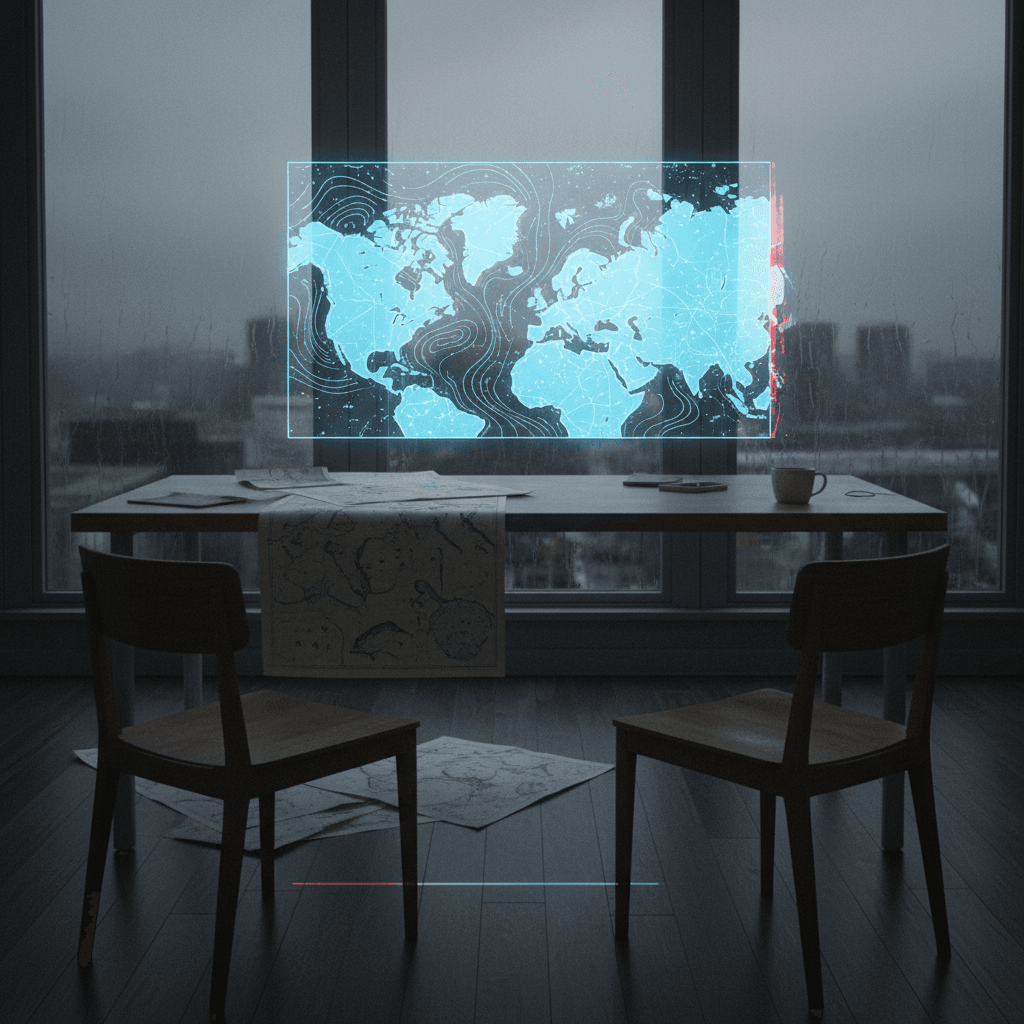
They were against the map desk, both half-dressed, the charts of the North Atlantic already on the floor — he'd swept them off with one forearm, then apologized to the paper, which is the detail that makes me think it's true, because who invents a man saying sorry to Greenland. The territory display was still on. It's always on. It turned them the color of things pulled from deep water, blue and a little dead, and she kept catching sight of her own hand on his chest looking like it belonged to a drowned woman.
They'd done this before. That's the thing she buried in the middle, the way you bury the real news. Years ago, before either of them knew the other's job — him an American with a squint and a laugh that lands late, her a logistics coordinator with ink on her fingers she never gets out. They met when nothing was at stake. Then the network hired him to watch what her firm shares, and she became a proximity risk with a name, and he became the mechanism. They didn't touch each other for two years, which is its own kind of touching.
So when it happened again it was a re-enactment. Same office. Same burnt coffee on the warmer since morning. Same map. She said they narrated it — the refusal to be solemn was the game. He stopped in the middle, his mouth at the hinge of her jaw, and asked, deadpan, whether this counted as sharing information. She laughed so hard he had to hold her still. She said: unusual proximity event. He said: highly — yeah. Highly. The laughing was the whole point, she said. His hands knew exactly where to be and asked her anyway — is this — yes — this — yes — and it was the asking she couldn't get over, a man whose job was to know things declining to assume the one thing.
The rain was doing that diagonal thing on the tall windows. The heating hummed its mineral note. She told me his tan lines didn't match the weather and she'd wanted, stupidly, to ask where he'd gotten them, and didn't, because that was access, and access was the whole problem. For one hour she wanted a body that wasn't a negotiation. One relationship in her life that wasn't her owing someone a report on herself. I think about that a lot. How reasonable it sounds and how impossible it is.
Which is when she saw the report.
Not saw — he told her. After. He was buttoning his shirt wrong, one off, and he said it the way you'd mention rain: the flag's already in. She thought, fine, we log it, we're adults, unusual proximity, submitted, done. Then she looked at the timestamp on his tablet where it sat glowing on the drowned-blue desk.
The report predated the act. By forty minutes.
He'd filed it before he came upstairs. He'd flagged himself — the auditor auditing his own compromise — before his hands were anywhere near her. Not caught. Not confessing after. He'd chosen it cold, downstairs, in the rain, and then climbed the stairs.
She said the tenderness and the surveillance were the same gesture, and that was the thing that undid her, worse than any of it. The most watched she'd ever been was the most chosen she'd ever been. He'd made her a permanent record on purpose. Filed beautifully, she kept saying. She'd read enough of his flags to know his prose. Clean. Precise. And this one about her.
I asked what she did.
She opened it. Sat down half-dressed in the map light and read what he'd written about the two of them, in that voice she trusted, and he stood there and let her.
She wouldn't tell me if she deleted it.
I think she's still deciding. I think that's the same as no.