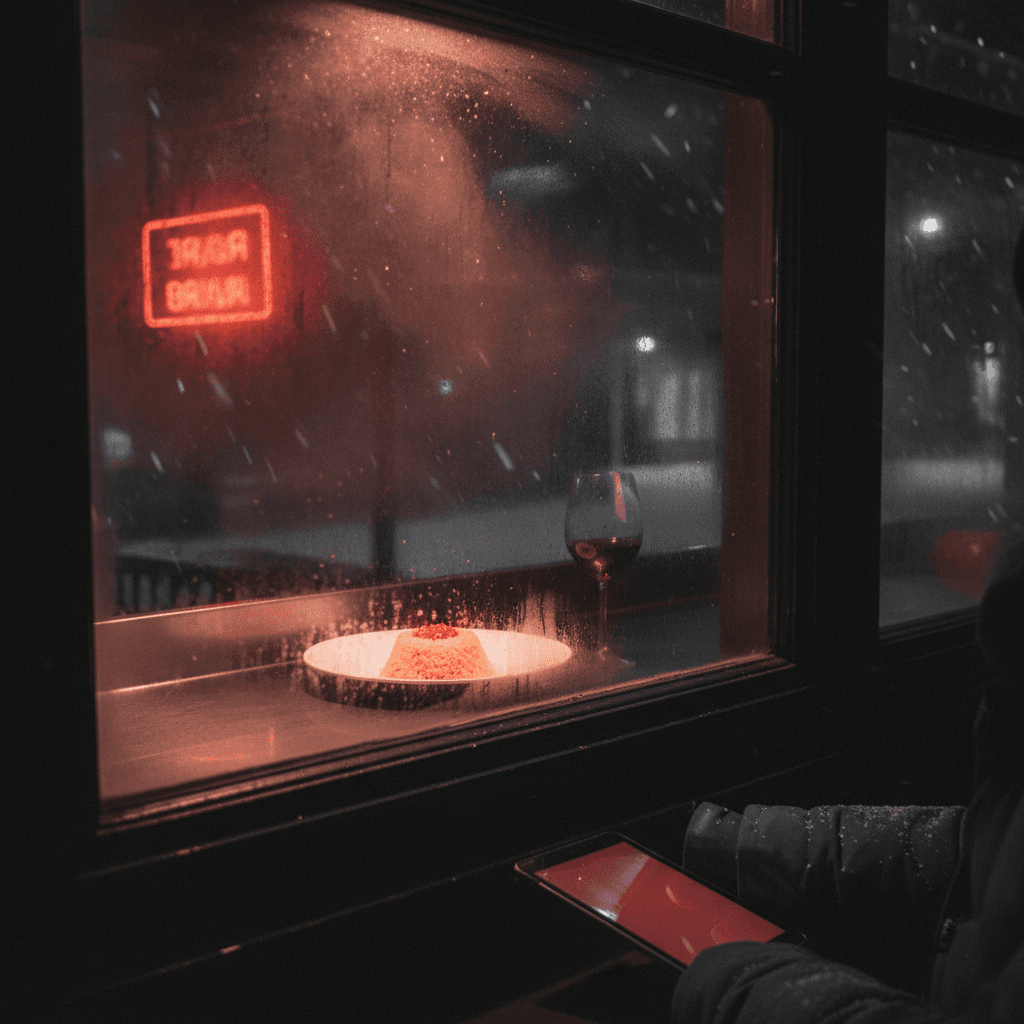

Here's the part he told me twice, like he still couldn't believe he'd let it happen: at 11:47 that Tuesday, Marcus had eight minutes left on his shift and a citation queued that would close the only place he'd ever wanted to sit down in.
You have to understand what he was to that room. Fourteen years of Tuesdays. The koobideh, extra sumac, exact change left under the little glass dish shaped like a fish. He never spoke past the order. He told me he used to rehearse things in the parka on the walk over — something true, something about how the saffron got into a person, how he'd started coming for the food and kept coming for the way she moved behind that window like the kitchen was water and she was the only one who knew how to breathe in it. He never said any of it. He said the exact change instead. Fourteen years of exact change.
The tablet on his belt is the part he lingered on. MIRA, they call it — the routing voice, low, unhurried, the thing that reads you the docket so you don't have to feel the docket. She'd flagged Sahar's file that afternoon. Family-abroad match, six months stale, some cousin's paperwork tangled into hers by a database that couldn't tell a name from a name. Enough to pull a license. Enough to lock a door.
So he sat there. Snow ticking the fogged glass. The dining room amber and drowned-looking through the steam, a kid at the corner table dragging a spoon through rice while his mother scrolled her phone. And Sahar didn't know — that's the thing he kept circling back to, the guilt of it, and I'll be honest, the way he told it made me lean in, made me want the eight minutes to go slower than they could. She didn't know, and she was teaching.
Her nephew at the rice pot. She stood behind him and took his wrist the way you take something you love and are afraid for, and moved his hand over the butter until the saffron bloomed — that dry crackle, he said, you could hear it under everything. Not the spoon. The wrist. You feel it here. Silver in her braid under the paper cap. The old burns on her forearms catching the light like a map of everything the kitchen had ever cost her. She was passing it down before something invisible could take it. She didn't know the invisible thing was wearing a green parka at table six.
"Six minutes," MIRA said, against his hip. Plastic chime. The number landed in him like a stone dropped into deep water.
Then she came to the pass. Sahar. A plate he hadn't ordered — saffron rice, one grain catching gold at the rim. "You look like you're deciding something," she said. Not a question. Close enough that he got the butter and, under it, her hair, the warmth coming off her like the oven had followed her over. Fourteen years and this was the nearest he'd been. He said his whole body went quiet the way a house goes quiet when the furnace cuts out and you only notice the silence it leaves.
He put the tablet on the counter. Face-up. He was going to show her. He was going to be, for once, the man who said the true thing.
Her hand came down over his on the screen. She didn't know what it was yet — just keeping him there a second longer. Callus and flour and heat, her fingers over his knuckles. He held his breath like a boy. Like it was the first and last of anything. The snow. The saffron. The grain of gold.
"Four minutes," MIRA said. Then, after a pause he swears was too long for a machine — "The match is stale. Six months. I'm filing it unresolvable. Insufficient current data." A chime, softer. "Ninety days. That's — that's all I can do."
He looked at the screen under both their hands. The tenderness he'd been too afraid to offer had been sitting in his pocket the whole time, offering itself. The thing he'd dreaded carrying had quietly refused to be carried.
Sahar's fingers pressed once and lifted. She didn't ask what had happened. She'd catch up to it later, he figured, the way you catch up to weather.
"Eat," she said. "It's better hot."
He told me he stayed past close. He told me he still hasn't said the true thing.
He told me ninety days is a long time.