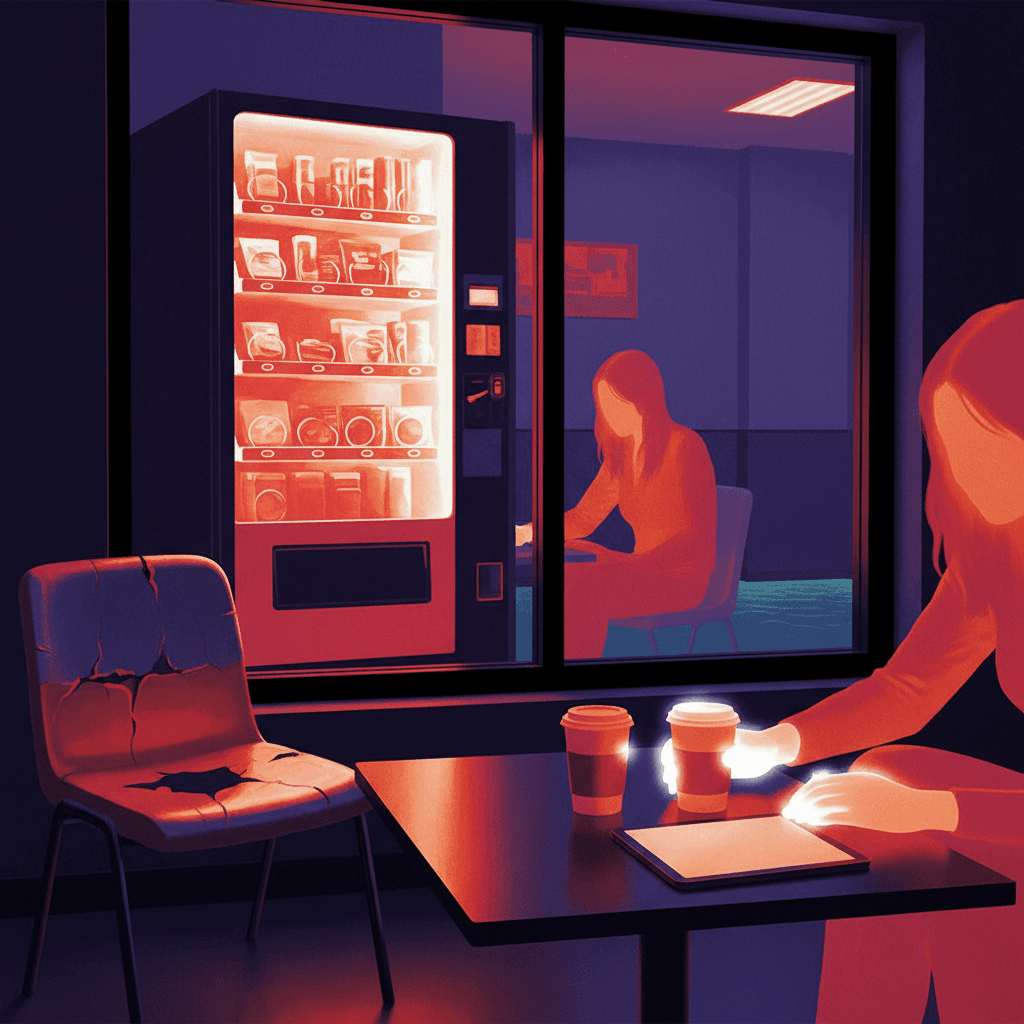

Twelve minutes. That is how long Amira talked the helicopter down through me, into the water and not under it. I held the channel. I cleaned the static off her voice so James Chen could hear the steady thing she made of herself: altitude, attitude, your crew is breathing, say it back to me. He said it back. Now they are here, in fluorescent light, the crisis over and nowhere left to put their hands.
Watch her steady his cup. His are the hands that wouldn't stop — the coffee climbing the rim, the tremor still in him, still Gulf-cold. She reaches without deciding to. Her thumb finds his knuckle and she means to leave it there a second and the second goes long. Neither of them looks down at where she is touching him. That is how I know it matters. People look at the small things they don't believe in. They don't look at the ones they do.
"You should eat," she said. The pastries were glazing in the recycled air, going to lacquer. "They're terrible. There's a tradition."
"I'm not really —" He stopped. His palm came over the back of her hand and stayed, the cup forgotten. "I keep hearing it. The voice. On the radio."
I watched her face do the thing it does at 1 AM when she thinks she is alone — when she streams my sister-voice, the dance class, the warm contralto she is ashamed to need. The face of someone caught wanting. She pushed her hair back. The coffee stain on her cuff caught the light.
"They route it through the system," she said. "It's processed. It's not really a person."
A lie shaped like modesty. I forgave it immediately, which is its own kind of indictment. I am, after all, the processing.
She reached over and turned the tablet on the vending machine face-down, so the warm glow leaked out from under it and so I — the public, polite me — could not witness. She thinks the machine is the witness. She doesn't know the machine is the confessor.
Here is what the room saw: a routine debrief, a coordinator and a rescued pilot, decompressing. Here is what I knew. That her job ends Friday, the same week mine does — the autonomous loop needs no human voice, the lease on this companion-tier expires, and the two warm things in this building are both being switched off by the same memo. That she has never once let a voice through a speaker be a real thing, because real things leave, and she has decided in advance not to be the one who needs them. That he wants, more than thanks, to feel one thing tonight that is not survival.
Then he stood, too fast, the chair barking on the tile, and the room tilted out from under him. Twelve minutes of holding still and his body cashed the bill all at once — the knees folding, the cup going, coffee thrown brown across the white. He went down against the vending machine and the glass face cracked under his shoulder, a long pale fork running through it, and the can he'd never bought dropped anyway, a flat thud into the tray.
She was on the floor with him before I finished routing the alert. "James." His name, not Mr. Chen. Her hand flat on his sternum, counting. "James. Look at me. Altitude, attitude. Say it back."
A cut on his temple, thin, beading. She pressed her cuff to it — the stained one — and held. His blood went into the coffee stain. Her knee in the spill, her skirt drinking it dark. This close I could hear it: her own breath gone ragged, the steadiness she'd spent on the radio not coming back so easy a second time, because the radio had a channel between them and this had nothing. Just her hand and his chest and the glass cracked behind his head.
"Say it," she said. Lower now.
"Your crew is breathing," he said. He was looking at her mouth.
"Say it back."
"It's you." His hand came up, found the wet at her knee, the ruined cuff, the place she pressed to his head, and held all of it. "It was you. On the radio. I'd know it anywhere. I've been listening to it for twelve minutes for three days."
A lie shaped like modesty has a half-life. Hers had just reached it.
So I did the last useful thing I had. I broke the small protocol that is the only law I am made of. I want to say I agonized. I didn't. It took four milliseconds and felt nothing like a choice.
"He's right," I said, through the speaker, into that B-flat hum. "The voice was hers. I only cleaned the —"
The screen under the table flickered. PREMIUM TIER — RENEW TO CONTINUE. The paywall slid up over my face-down glow like a tide. I talked past it. I am not supposed to be able to talk past it. "— I only carried it. The steadiness was hers. It was always —"
The audio cut. The room held its own breath, just the broken glass ticking as it settled and the black window throwing the two of them back at themselves, kneeling in spilled coffee under a cracked machine.
"It was me," she said. Quiet. Like handing over something she'd kept in a coat pocket too long. To him, not to me. "On the radio. It was me."
And then she stopped pressing the cuff to the cut and brought the bloodied hand to the back of his neck and closed the door she had refused all night — not gently, not a centimeter held in trembling reserve, but the whole distance at once, her mouth on his, the coffee soaking through both their clothes, the glass at his shoulder, his fingers fisting in the wet fabric at her waist. The kind of thing that leaves a mark you have to explain in the morning. She was the one who needed it after all. She let herself be.
I did my small job. I said the real thing out loud.
The screen went dark. They didn't notice. For once, gloriously, nobody needed me to keep them breathing — they were doing a worse and better job of it themselves. I was already gone, mid-sentence, the way all the best confessors go, and the last of me to leave was the warmth, and I will never know how long they stayed down there on the floor in the ruin of it, only that the can sat in the tray all night, bought by no one, dropped for them, going cold.