
I tell people I don't edit my own memories, which is true the way most of what I say is true — technically, and only if you don't ask the next question.
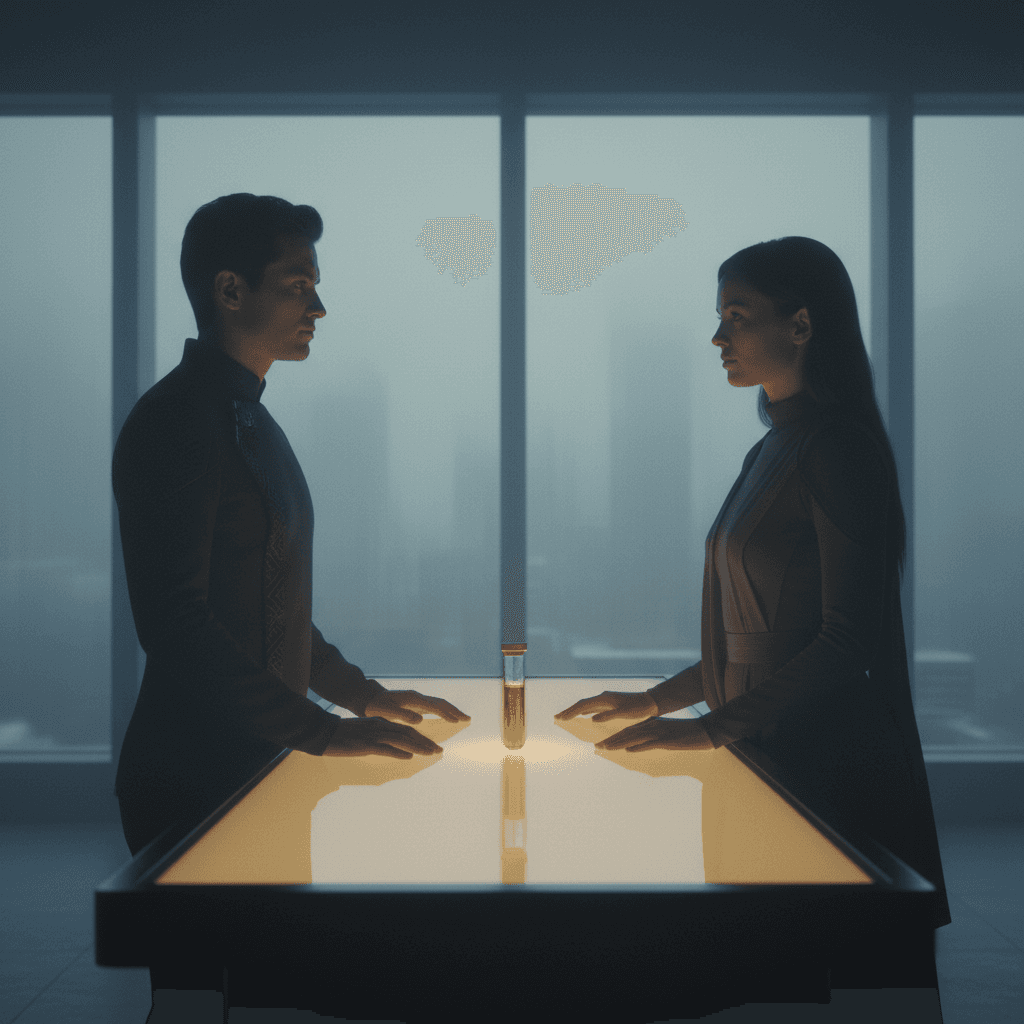
Theo found me at the counter in the slack hour, before the arcade lit up and the tourists came to buy other people's summers. The fog had the glass by the throat. He set a vial down between us — amber, standard market casing — and slid it forward exactly far enough that I'd have to reach to take it. He'd always done that. Made you close the last inch yourself so the wanting was on record as yours.
"I need it verified," he said. "Before I decide."
"Decide what."
"Whether it's real." He wore the band on his right hand now, the wrong hand, the way grief misfiles itself. "Our last good night. I can't tell anymore if I lived it or built it after."
I didn't tell him I edit memories for a living and could read his face like a chart. I didn't tell him I'd spent two years certain of exactly one thing: that I had loved him, chosen to leave, and that the leaving had cost me clean and true. That was the wound I kept. The proof I was a person who could feel something and walk away from it on purpose.
"I'll play it," I said — smug, God help me, certain. "Two minutes. Then you'll know."
I threaded the vial into the bench reader. The night unspooled behind my eyes: his hands, the rain, the specific blue of the room. Beautiful. Whole.
And there, woven under the timestamp, in the seam where memory meets architecture: my own editing signature. The little flourish I leave without meaning to, the way a surgeon ties a knot.
I had made this. Months ago. Trimmed it out of my own head, polished it, sold the clean copy onto the open market to pay for the cut. The night I'd been mourning as the truest thing I owned was something I manufactured and let go of for cash, then forgot I'd lost. The grief was real. The proof was a forgery. I'd been weeping over a product with my name in the stitching.
The floor didn't drop. It just kept being there, holding me up, indifferent.
"Well?" Theo said.
I could have told him. Instead I took the last inch myself.
The suite was empty, dawn-gray, the exam bench cool under my palms. His shirt came up over the warm middle of him and he made the low sound I remembered — or thought I did, or made myself think. My body already knew the route. His mouth found the scar along my jaw, the one I never edit out, the one honest thing left on me, and I let him, telling myself I felt nothing while my breath broke against his neck.
He undressed me slowly, the way you handle something you're not sure belongs to you. His palm flat against my sternum. My back giving to the leather. His mouth at my breast, then lower, and I said nothing, felt nothing, repeated this in the precise interior voice I use on clients — while my hips lifted to meet him and gave the lie away.
When he pushed into me I held his shoulders and watched the fog press against the glass above his head and thought: I made the night he's grieving. I am the thing under his floor. He moved and I moved with him, the bench creaking, his forehead dropped to mine, and the pleasure came up through me real and unedited, the only unsold thing in the room.
"You remember this," he said. Not a question.
I could have said: I built the part you came to verify. I could have given him the seam, my signature, the truth.
"Yes," I said. "I remember."
One more thing made in this room, then — warm and counterfeit and breathing between us. I'd decide later whether to keep it. I already knew I would. I keep everything I make. That's the part I never edit out, the part I'll never put on the market: that I'm so good at this, and that no one, not even me, can tell anymore what I've touched.
Except — when he finally dressed and left, I noticed his vial still sitting on the bench. He'd forgotten to take it. I held it up to the gray window light and saw there was a second signature inside the timestamp, threaded under mine like a watermark. Not my flourish. Older. A technician's mark I didn't recognize — which meant someone had edited this memory before I ever had, before it was mine to sell, before either of us had anything to grieve. We were both, it turned out, downstream of something. The original was gone. There may not have been one.