
The first thing you learn on the line is that nobody says what they mean. The kitchen has its own language and it is entirely made of objects: a spoon set where your hand will land, a towel folded and left at your station, the burner turned down behind your back when you're in the weeds and too proud to say so. Ren learned this at nineteen. She is twenty-eight now and fluent, which is why it takes her eight months to notice what Elias has been saying.
It goes like this. Family meal at four-thirty, the whole crew eating fast off hotel pans — and on Ren's plate, somehow, always, the crispy bits. The corner of the lasagna. The burnt ends. The chicken skin, shattering, amber, the part everyone fights for, appearing on her plate without ceremony while Elias looks at something else entirely.
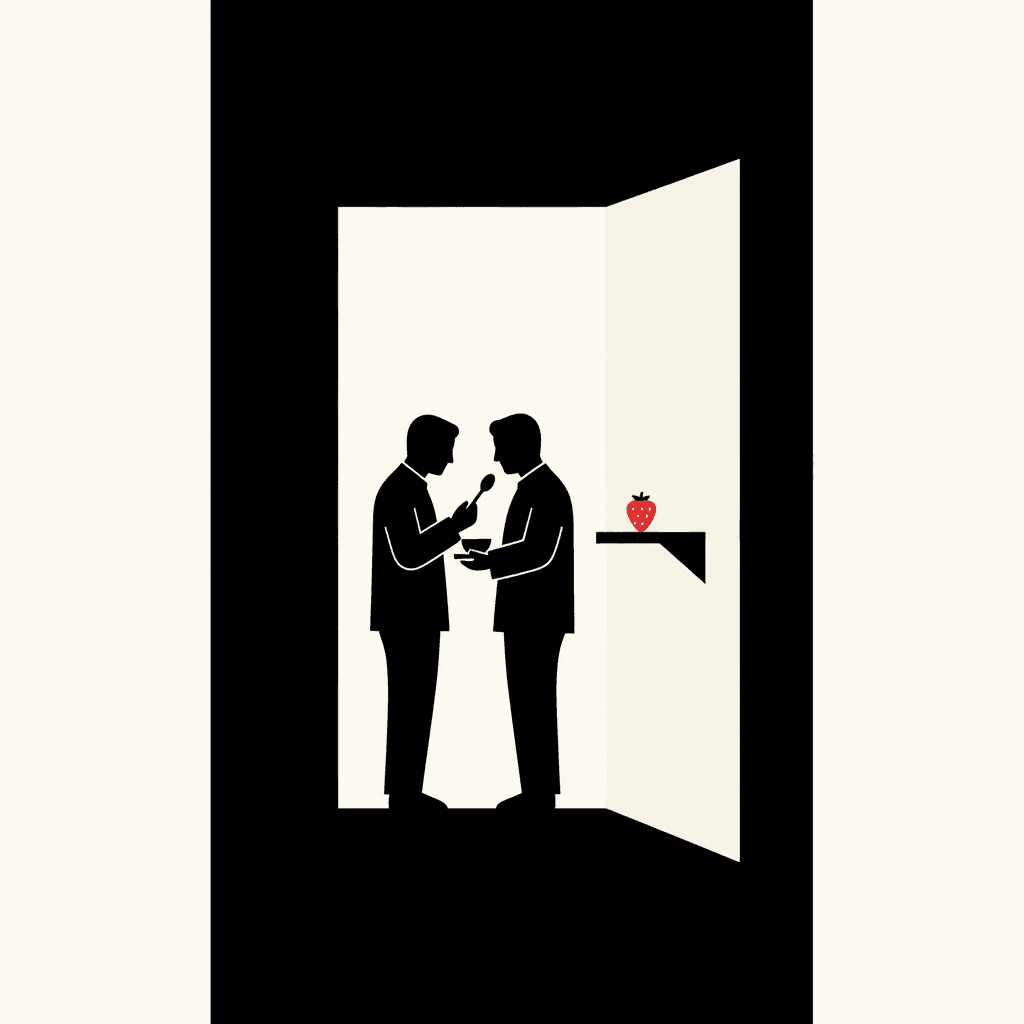
It goes like this. First strawberries in June, the flat arriving from the farm like rubies packed in cardboard, and the unspoken rule is chef tastes first — and there is Elias, sous chef, second god of this small hot country, holding the flat out to her station. "Tell me if they're worth it," he says, frowning at his clipboard like the strawberries are a paperwork problem. The first strawberry of summer, warm from the truck, and it detonates on her tongue, sweet all the way through, and when she looks up he is watching her face with an attention that has nothing to do with fruit, and then he is gone, calling out about the fish delivery.
It goes like this, nightly: the tasting spoon. "Taste this," the kitchen's oldest sentence, and he holds the spoon and she leans in and takes it, her hand steadying his wrist, his eyes on her mouth in a way that is professional, that is completely professional, that is — later, in the loud privacy of the subway home, she will put her own hand around her own wrist, measuring something.
Eight months of this and she has told herself it's the language of the kitchen, objects meaning care, care meaning nothing personal. Everyone feeds everyone here. It's the job. The job is feeding.
Except.
Except that tonight, a brutal Saturday, three-eighty covers and a printer that would not stop screaming, she watched him work the pass for six straight hours — sleeves rolled, forearm scarred like a map of old rivers, that terrible calm he has, plating with two fingers like the food is sleeping and he won't wake it — and somewhere around the three hundredth plate, watching him wipe a rim with a folded towel, precise as surgery, she thought, with no warning at all: I want that attention. And the thought had a temperature.
Now it's one a.m. and the kitchen is breathing out. Line broken down, burners cold and ticking, the floors done, everyone gone or going — Marisol shouting something filthy and affectionate from the alley door, the dish pit dripping itself to sleep. Ren is in the walk-in doing the last temp log because it's her week, and the walk-in is its own small winter, breath visible, the compressor humming its one note. Shelves of tomorrow: butchered proteins in neat trays, quarts labeled in Elias's block letters, ELIAS'S — DO NOT TOUCH on a deli container of something nobody has ever dared open.
The door swings and it's him, clipboard, doing the order. The walk-in is not large. They work around each other in the cold with the economy of people who have shared a line for eight months, his shoulder passing behind hers close enough to raise the hair on her neck, and she reads temps and he counts quarts, and the door —
The door swings shut, the way it does. The latch clicks.
Here is the thing about the walk-in door: it opens from the inside. It has a glow-in-the-dark plunger handle, mandated, maintained. Every cook in the city knows a walk-in-trap story and they are all, every one of them, either ancient or invented. The door opens fine.
Neither of them opens it.
She becomes aware of the cold as a pressure and of him as a heat source, one shelf away. He's stopped writing. The compressor hums. Her breath and his breath, visible, mingling in the middle distance over the tray of chickens.
"Ren." Quiet. In eight months he has said her name maybe a thousand times — fired it down the line, called it over the printer. Never once like this, in the cold, at one a.m., with nothing ordered.
"I know," she says. Because she does, finally, the arithmetic arriving all at once: the crispy bits, the strawberries, the towel folded at her station on the night her father called with bad news and she told no one, no one, and found her station somehow prepped when she came back from crying in the dry storage. Eight months of a man saying it in the only language he trusts.
"The crispy bits," she says. Her voice does something on bits. "Every night, Elias. You gave me the chicken skin. Do you understand that in this building that's practically a deed."
The ghost of a laugh out of him, one breath of it, fog in the cold air. He sets the clipboard down on the shelf of chickens, deliberate, a man laying down a weapon.
"You knew," he says.
"I know now."
He crosses the walk-in, which takes one step. This close he smells like the whole night — smoke and thyme and the faint sweetness of caramelized onion in his collar, sweat under it, cold air over all of it. He lifts one hand and takes her wrist, the same wrist that steadies his tasting spoons, and turns it over, and presses his thumb — just his thumb, callused, kitchen-hot against the cold — into her pulse. Holding it there. Reading her like a temp log. Her heart is throwing itself against his thumbprint at some disgraceful number and they both know it, and the corner of his mouth admits it, and that admission is the single most obscene thing anyone has ever done to her in a professional kitchen.
"Since June," he says. "The strawberries. You want to know how the flat made it to your station? I took it off the pass. From under Chef's hand." A beat. "I'd have taken it out of the fire."
She kisses him or he kisses her — the plating is ambiguous, they will argue about it for years — and the cold makes his mouth feel scalding, and he kisses the way he plates: unhurried, exact, total. Nothing wasted. His hand slides under her chef coat where her side is furnace-warm from six hours of service, fingers spreading over her ribs like he's checking a temperature he already knows, and she pulls him in by the apron strings, actually by the apron strings, and the shelf of quarts rattles behind her and neither of them stabilizes it. Her whole body is one held sauté pan, heat looking for something to do. He breaks off to breathe her name into the join of her jaw and it fogs, visible, her name in cold smoke against her skin, and she watches it happen over his shoulder and thinks: eight months. We wasted eight months speaking in chicken skin.
The compressor cycles off. In the sudden hush they are two people breathing hard in thirty-eight degrees, her hands in his hair, his forehead dropped to her shoulder, both of them laughing low at nothing, at everything, at the tray of chickens bearing witness.
And then boots, outside, unhurried, and the door swings open — Chef, off-whites on, keys in hand, taking in the scene with one flat sweep: his sous and his fish cook, wrecked and radiant among the proteins.
A silence with texture to it.
"Temp log done?" Chef says.
"Done, Chef," Ren manages.
"Good." He's already turning away. "Lights when you leave." The door sighs shut behind him. Through it, receding, absolutely deadpan: "About time."
Family meal, the next day, four-thirty. The whole crew off the hotel pans, Marisol mid-story, the printer quiet, the light going long and gold through the porthole windows. Elias comes down the line with his plate, and stops at Ren's station, and — in front of everyone, in the full light of day, with a look on his face like a man signing something — scrapes the crispy corner of the lasagna onto her plate.
Marisol stops mid-story.
"Finally," says the entire kitchen, in one voice, like a service call.
Ren eats the crispy bits. They're worth it. They were always worth it.