
The drawer screams when she opens it, the way it always does at this hour, and James — flattened against the cold steel of cabinet 114, camera still warm in his hand — understands that Makeda has known he was here for weeks.
"You can come out," she says, not turning. "The lens cap squeaks. You always forgot to oil things."
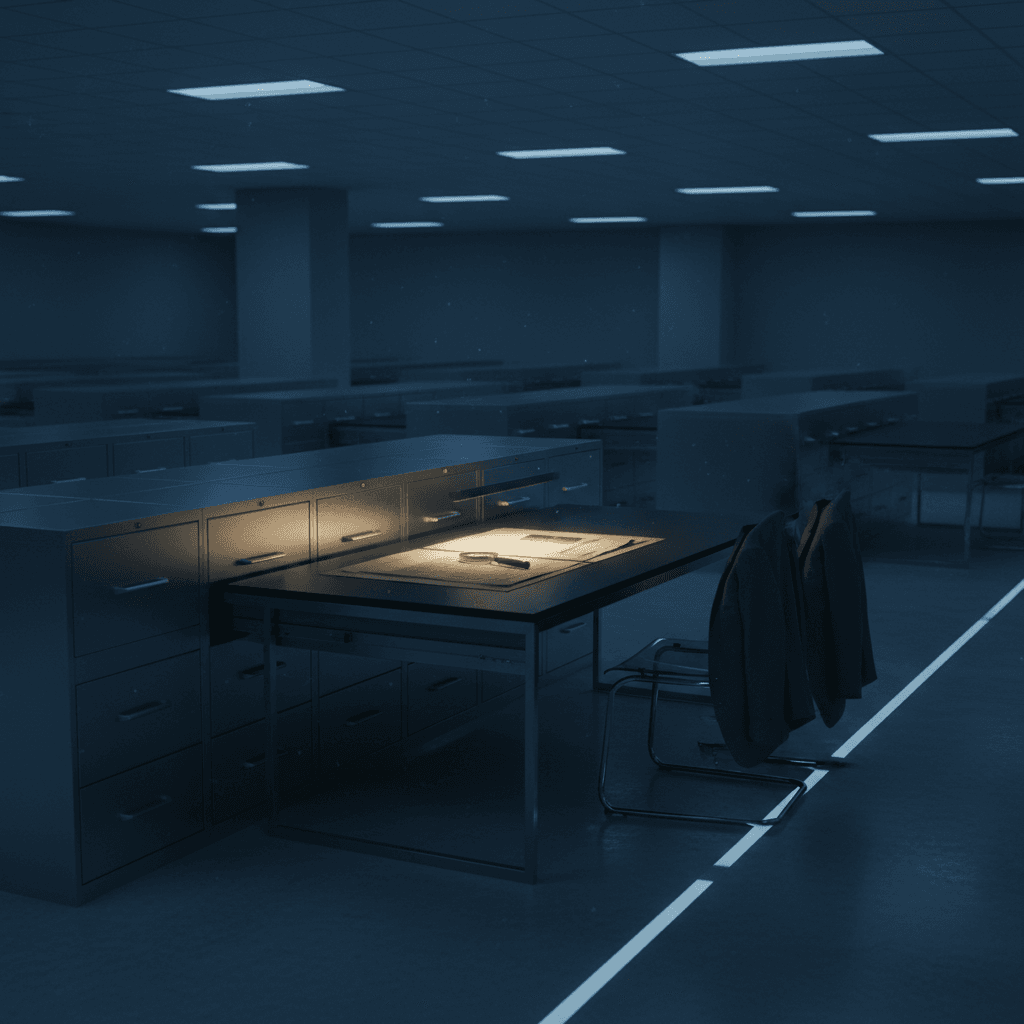
He steps into the tabletop light. It is merciless here, full-spectrum, the kind that turns a face into a contact sheet — every freckle on his hands legible, every wrinkle confessing. She is across the examination table from him, glasses pushed up into the silver, gloves on, a print between her fingers. Roy DeCarava, maybe. A woman in a kitchen, light coming sideways.
"You're pulping them," he says. His voice comes out wrong, thirty years of vault hush in it. "I catalog the lists. I know what's coming up from your office. The whole second floor of seventies work, the women, the —"
"Sit down, James."
"Don't manage me."
"I'm not." She sets the print on the table, face up, between them. "I'm asking you to look."
He doesn't sit. He comes around the table instead, slow, the way you approach an old argument, and he puts his bare-fingered hand flat over the print to stop her taking it. She puts her gloved hand over his. Neither lets go. The only sound is the desiccant system breathing, holding the room at fifty percent forever.
"Read the drawer," she says.
He reads it. Stenciled fresh on the steel: DO NOT DIGITIZE. DO NOT DESTROY. Inside, in their archival sleeves, the women. The Black photographers of two decades. The ones on the official cull list she was handed by the floor above her, the list he has spent his nights photographing in panic, thinking he was the last witness.
"The list is theater," she says. "I move them down here. I report them gone. They burn paper that doesn't matter and they think I'm efficient." A breath. "I needed someone outside it to document, in case they ever audit me. I just didn't think it'd be you, breaking in like a —" Her mouth twists. "Like me."
He understands all at once that they have been performing the same rescue in different rooms for two months. That the danger is the same danger. That he made the wrong choice once, chose the institution over her, and she built a life of choosing against it from the inside where it could ruin her, and he never knew, and the not-knowing is the thing that finally breaks.
She peels the glove off her right hand, finger by finger, deliberate, the way she develops a print — and lays the bare hand against his jaw.
"This is a terrible idea," she says.
"Yeah."
"We are too old and there's a camera running and we hated each other an hour ago."
"You didn't hate me."
"No," she admits. "That was the problem."
He kisses her against cabinet 114 and the steel is cold through her shirt and his mouth is at her throat, the stubble he forgets to shave dragging, and she laughs once — low, guilty, a sound he hasn't heard in three decades — because they are doing this here, in the one room they both swore to protect, and the wrongness of it is exactly the size of the wanting. Her hand finds him through his trousers, unhurried, certain, those darkroom hands that know how long to leave a thing in the developer before it's ruined. He says her name into her skin. She unbuttons him. The print lies safe on the table beside them, the kitchen woman in her sideways light, and Makeda thinks, with the part of her that never stops cataloging: this we did not save. This we never put away.
His hand goes under her waistband. She is already open to him, already wet, already saying yes, there, slow — and he is slow, because she taught him slow once and he never unlearned it. They hold each other up against the humming steel, two people who have stopped pretending the pull between them was ever a choice they made.
Afterward she doesn't move away. Her breath comes back in stages, uneven, real. She reaches sideways without looking and straightens the DeCarava print one centimeter to the left, an involuntary correction, the habit of thirty years, and he watches her do it and understands that this is what love looks like in a person like her — not the touch, but the adjusting afterward, the refusal to leave even a small thing crooked.
"Don't oil the lens cap," she says into his shoulder. "I want to hear you coming."