
Afterward, in the room where the ceasefire had not quite died, Sarah noticed he had stopped touching her the moment she said the word she meant to keep inside.
The word was *thank you*.
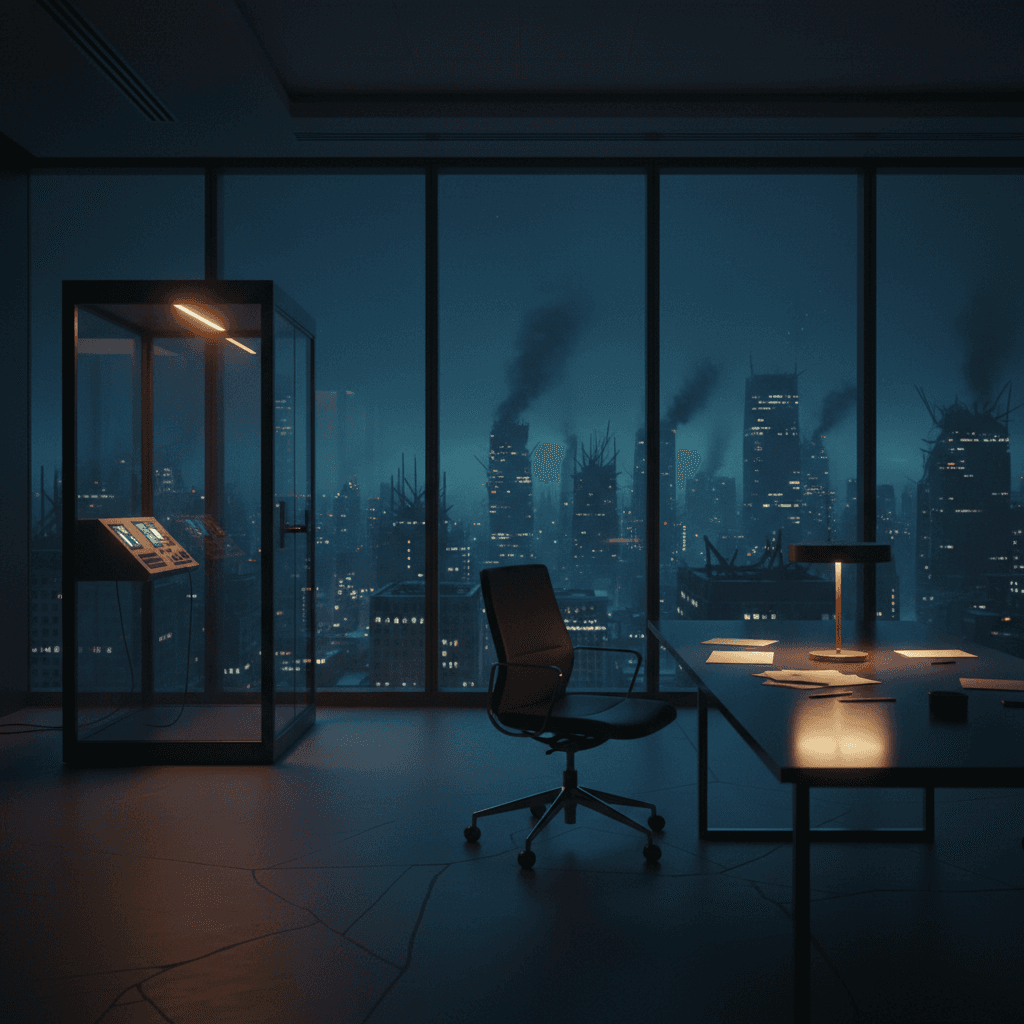
Until then his hand had been at the small of her back, where she ran cold, warming the place by degrees. They were half-righted. His shirt hung open. Her blouse she had not bothered with. The table smelled of cold coffee somebody had emptied, and past the glass the city showed its dark teeth, lit here, gone there. Somewhere below, a truck reversed, beeping its patient idiot warning into the dark.
She put her forehead to his sternum and felt his heart going. She knew his rhythms. This was not after-rhythm. This was a man bracing.
"You did it already," she said. Not a question.
His hand did not return to her back.
In the afternoon session she had watched him lean toward the microphone and skew the line by half a degree — *adjacent to* where the Hebrew had said *up to*, a word that gave back four hundred meters of orchard he had no right to give. She had not asked him to. That was the thing she had kept inside, until *thank you* let it out.
She lifted her thumb to his lip, to the old scar, the way she used to. He let her.
"You think I did it for the orchard," he said.
"No."
That was the ruin of it. He had broken the only thing he'd kept whole, and not for the cause she'd spent twenty years admiring him for refusing. For her. Which made him, finally, a man who took a side.
She had wanted that. She found she could not look at him.
In the corner the booth hummed, unplugged, glowing faintly, the way certain machines go on pretending.