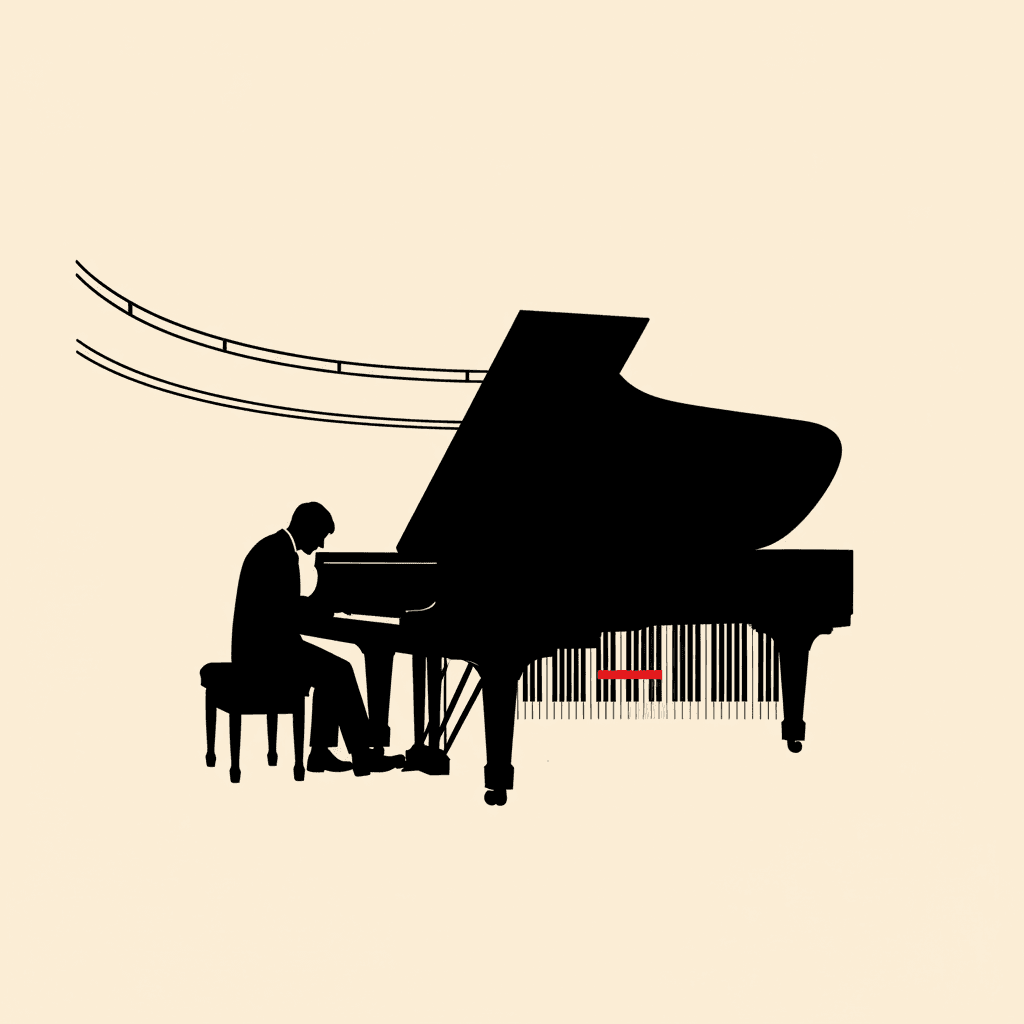

The trick nobody tells you about tuning a concert grand is that you're not making it correct. You're choosing where to hide the lie.
Twelve notes, and the math doesn't close — never has, not since Bach, not for anyone. Tune the fifths pure and the octaves go sour; square the octaves and you have to shave a hundredth off every fifth to make the whole thing agree to get along. Equal temperament, they call it. Everybody equally, tolerably wrong. Somewhere in there, if you're careless, one interval takes all the error at once and howls. We call it the wolf. My whole career is knowing which chord the pianist won't reach for, and burying the wolf there.
Marisol tunes with a machine. A little box, a clip-on mic, a green light that goes true when the pitch is dead center. She's thirty years younger than me and faster, and the committee books us both now — me for the Steinway in the big hall, her for the practice rooms, though last spring they started asking her about the Steinway too, which is how a man learns his ending is being scheduled.
We overlap on Sundays. The hall is empty and lit for no one, and we don't talk much, but she stays past when she's paid to, and I've stopped pretending that's about the piano.
"You leave it flat on purpose," she said once, hearing me set the A. "Two cents under."
"Room's cold at eight a.m. It'll rise into true by the recital."
She wrote that down. A woman who trusts a green light, writing down a thing that can't be measured, because a green light was never cold in a hall at dawn.
This Sunday she brought her machine and didn't clip it on. She sat at the keys and played — badly, the way tuners play, all intervals and no music, listening for the beats. Then she found it. Deliberately. She walked her left hand into the dead corner of the keyboard where I keep the wolf buried and she held the chord down and let it howl into the empty hall, that awful beating snarl, and she looked at me the whole time.
"Thirty-one years," she said, "and I finally found where you hide it."
I could have told her it's just arithmetic. That the error has to go somewhere. I have a whole speech; I've given it to apprentices.
I crossed the stage instead. I put my hand over hers on the keys, on the wolf, and held it there with her until the strings gave up the last of that beating and went quiet under our fingers — not fixed, just stopped, the way anything stops when you finally hold it still.
"Teach me the ear," she said. "Before they give me your hall."
"It's not the ear," I said. "It's choosing which note takes the damage."
She left the machine in its case. I set the A two cents flat, and this time she didn't write it down. She just listened, and let it be cold, and trusted it to rise.