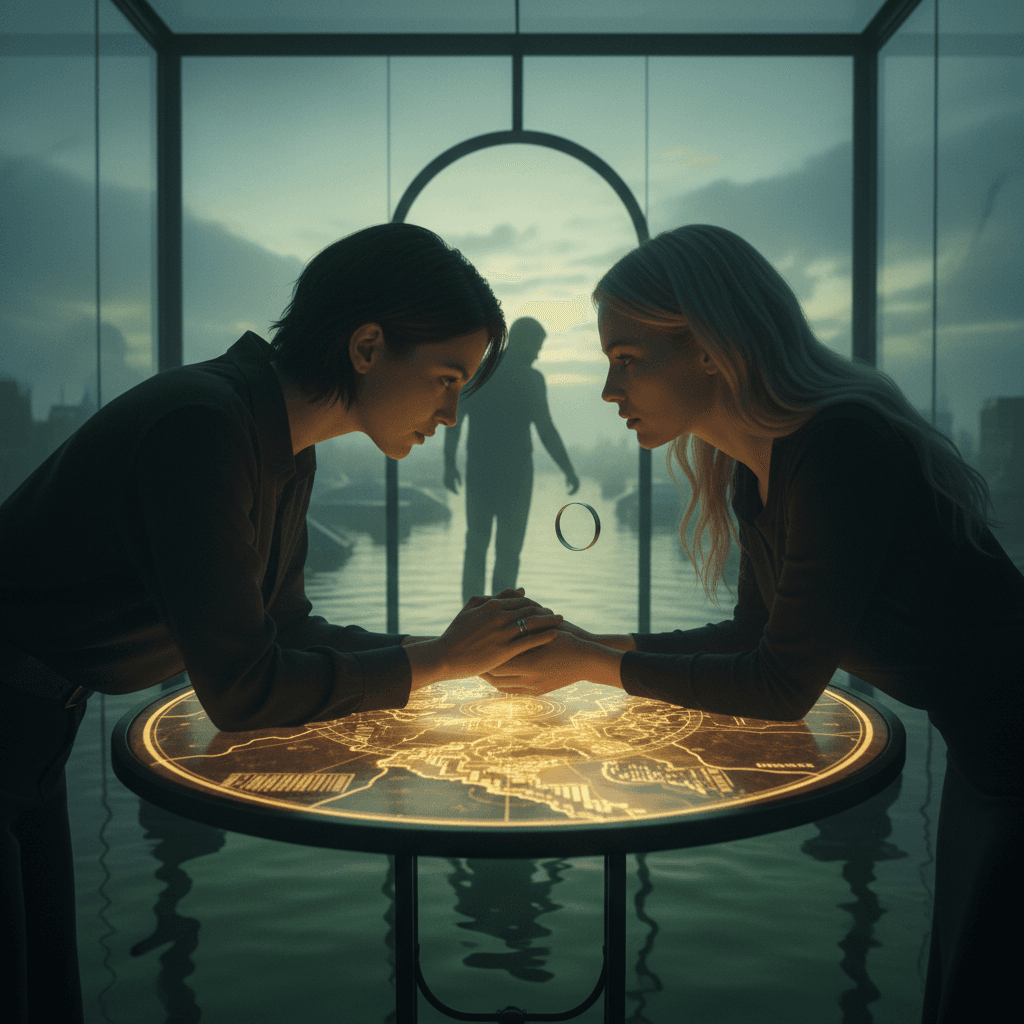

Every dawn my sister leaves a candle burning in the doorway so I'll know the woman has come to be mapped again.
I am always the last one awake. In the hall below me, forty strangers breathe in the loose synchrony of shared dreaming, their cuffs feeding them each other's sleep — a stranger's childhood meadow, a stranger's drowning, passed hand to hand like wine. I tend them. I keep the count. When dawn comes up green through the ferry glass, I climb to the sunroom to watch my sister fail to touch a woman.
Wren has her paper laid out, cotton stock she presses herself, and her ink-stained fingers are already moving when I reach the doorway. Calla sits across the map-table, cold hands wrapped around a clay cup she isn't drinking from.
"Start where you woke," Wren says.
"In the orchard again. But the trees were under water this time." Calla's laugh comes before the rest of it. "I could breathe. That was the strange part — not the trees, the breathing."
Wren's nib scratches. She draws the orchard as a thing seen from above, roots like nerves, and when she needs the tempo of it — that's her word, tempo — she reaches across the unmarked paper and lays two fingers on the inside of Calla's wrist. Just there, where the band of pale skin used to be on her own.
I watch the pulse pass between them through the only door it's allowed.
This is the ritual. Calla speaks her dream; Wren renders it by hand, refusing the interface that would record it perfectly, refusing to stream a single sensation across the eight inches of paper between their faces. Calla's breath crosses it. Wren's breath crosses it. Neither closes the distance. They have done this nine mornings and the not-touching has become its own architecture, load-bearing, holding the whole room up.
I know why Wren draws by hand. I am the reason.
She was twenty-two and the cuffs were new and I told her — God help me — that sharing a pleasure-profile wasn't intimacy. It isn't sex, it's nothing, it's just data, everyone does it. I wanted her unafraid of the new world. So she gave hers to a boy she barely knew, and he gave his to others, and the sensation streamed back to her diffuse and constant, pleasure with no body attached to it, until a real hand on her real arm meant exactly as much as a stranger's borrowed shiver three rooms away. Which is to say: nothing. I dissolved her, and called it generosity.
I have tended other people's dreams for eleven years. I thought it was work. It was penance.
Now Calla's fingers turn, slow, inside Wren's grip — not pulling away. Seeking. Always seeking warmer hands. And my sister's whole face changes, the way bark changes when rain finds it, and I understand that this is the first person Wren has wanted with nothing between them. No profile. No stream. Just the unbearable weight of a hand she has to decide to place.
"There's no more orchard," Calla says quietly. "I think the dream's finished. I dreamed it all the way to the end last night."
The nib stops.
Wren looks at the map — complete now, every root drawn, no pretext left for the fingers on the wrist. She does not let go. There is nothing to render. There is only her hand on Calla's pulse and the eight inches of paper and the green light coming up.
Calla doesn't move either. She is waiting inside the ache, the way she always says she wants to — staying in the slow want, not collapsing it into the instant of having.
Then, so small I almost miss it: Wren's free hand moves to the edge of the finished map and folds the corner down. A deliberate crease. Destroying the only thing left in the room that isn't the two of them.
I reach up to my temple instead, to the silver thread of scarring, and below it the dormant cuff I have worn so long I'd stopped feeling its weight. I work it loose. It comes away cold.
I step back from the doorway. The candle gutters.
Out on the gallery the tide is the color of old glass, and the city sleeps drowned beneath it. I open my hand. The cuff falls a long way before the water takes it, soundless, gone.
Behind me, in the green light, neither of them is speaking. The paper between them is finished and empty both at once.
I go down to the breathing hall, to the living, and I leave my sister the whole unmade weight of her own choice.