
She had spent the morning arranging a dead woman's memories into something her children could bear, and now she was sitting next to a stranger who hadn't yet decided whether to speak.
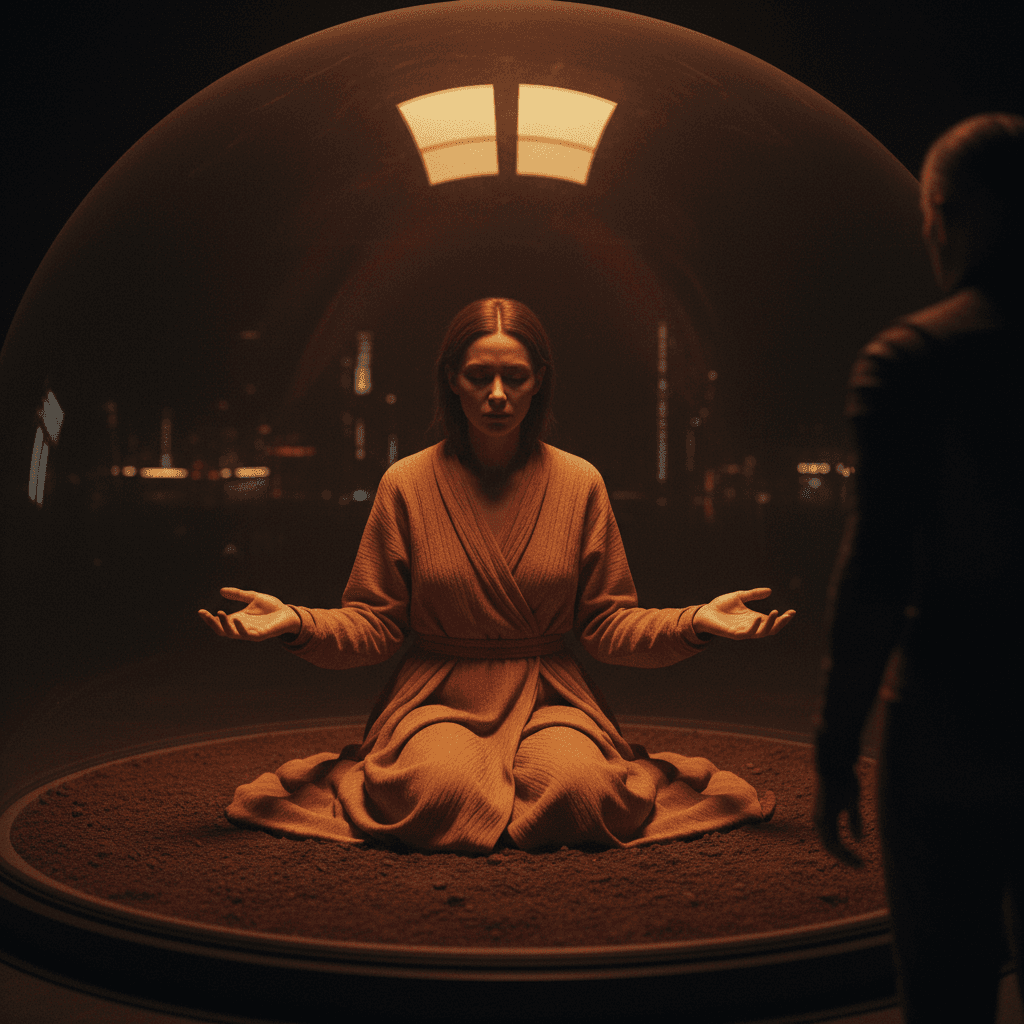
The Quiet held the day's last warmth. Six square meters of soil that had never known rain — only the slow drip of irrigation lines hidden beneath the bark mulch — gave off a mineral smell, cool and faintly metallic, like the inside of a coin purse. The persimmon tree carried three fruits, wrinkled almost to translucence, the light passing through them as through skin. Below, fourteen floors down, the city kept up its low animal hum, and once a freight carrier passed with a soft pneumatic exhale, like something large turning over in its sleep.
The bench was warm where someone else had sat.
"You don't have to perform anything here," he said, finally. His voice was lower than she'd expected, careful, the way his hands seemed careful — large, resting on his knees, as if he'd learned early that he could break things without meaning to. A small scar bisected his left eyebrow. She decided not to ask. She had spent the day inside other people's explanations.
"I don't perform," she said.
"You arrange. You told me. You make the unbearable into a shape."
She had told him that. In the first ten minutes, the way you confess to someone whose job is to hold it. A grief archivist. The dead woman that morning had loved a particular intersection at dusk, had returned to it in memory four hundred times, and Sela had threaded those four hundred returns into a single passage the children could play at the funeral without drowning.
"And what do you make of mine," he said. Not a question. He was looking at the tree.
She noticed, then, that she had stopped. Her thumbnail, which had been pressed into the soft center of her opposite palm — the small private cruelty she used to stay inside herself while she listened — had let go. Her hands lay open. She couldn't remember releasing them.
"I don't know what you do," she said.
"I said. Consultant."
"That's not what I asked."
He smiled at the tree. The amber light was going lateral now, cutting under the leaves, laying a warm bar across his forearm and the edge of the bench between them. His hand had moved without her seeing it move. It rested near hers, not touching — a hand's width, then less. She did not close the distance. Neither did he. The not-touching had a texture. She felt it along the inside of her wrist like the memory of heat.
"I had a thing I wanted to say," he said. "To one person. Without it being—" He turned his palm up, briefly, then let it fall. "Stored somewhere. Scored. Turned into a shape for someone else to bear."
"Say it."
He looked at her for the first time fully. Forty-one, she'd have guessed, with the kind of stillness that costs something to maintain. "This is the most honest hour I've had in a year," he said. "And I'm aware that I'm telling that to a person whose presence I arranged."
"You didn't arrange me," she said, gently, because this was the part she understood — the asymmetry she had been resting in all afternoon like a hand in warm water. "I was assigned to you. It's all right. It doesn't make it less true."
He frowned, slightly. Then the persimmons caught the last of the light, and he reached for his coat.
His sleeve rode up. The session display on his wrist woke at the movement — a habit, a glance toward time. She saw it before she understood she was seeing it. The format. The pale green confirmation band, the duration, the line that read *billed to.*
Identical to hers.
A client, not a companion. He had booked the hour the same way she had booked it — separately, privately, each of them paying for the possibility of the other. No one had assigned anyone. Two people had each decided, alone, that an honest hour was worth the price of pretending it was given.
Her hands had found each other again. The thumbnail had returned to its place.
"What was the thing," she said. "That you wanted to say."
He stood. The bench cooled where he had been.
"I think you already know it," he said.