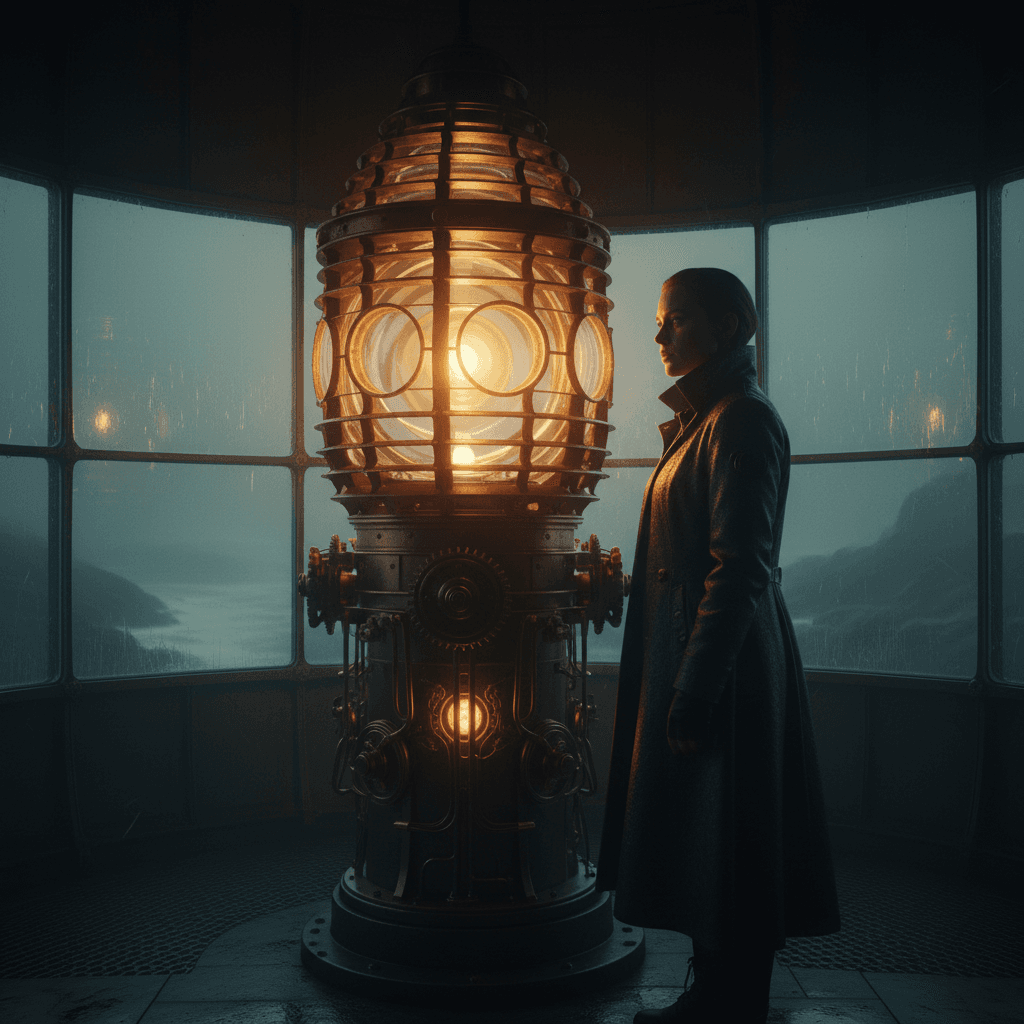

The dead leave their wanting in the walls, and it was Sable's particular profession to go in after it.
She had come to Porer for a dead man's grief. The lighthouse rose from its rock like a thing that had decided not to drown, and inside its lamp room the brass housing of the old beacon still held the warmth of the night cycle, though it had stopped turning years ago. She set her interface against the cold curve of the lamp and felt the heat through the casing, a borrowed fever.
Ivor Crane watched her work without watching. He had the stillness of someone who had spent a great deal of time being the only moving thing in a place. When he shifted his weight she heard the subsonic hum of his lace come up behind his ear — a sound she had begun, without intending to, to wait for. It told her when he was paying attention. She had not decided yet how she felt about being its object.
"He kept the windows clean," Ivor said. The first full sentence in an hour. "Even after he couldn't see the point. He said the glass was the only honest part of the job."
"You learned from him."
"I learned the windows." A pause that was almost a smile. "The rest I'm improvising."
The pattern came up slowly, the way they always did — a haze of the previous keeper's domestic ghosts, the neural echo of a life pressed into a system over decades. The kettle's schedule. The particular way he liked the lamp room lit before sleep. The route his attention took at dusk, a worn groove. She mapped it as a topography of loss, the low places where the missing person used to be.
To read it she had to move. The room was a glass cylinder hardly wider than a held breath, and the archive nodes were spaced around its circumference, so the work was a slow circling. Ivor circled too, keeping the lamp between them and then not, adjusting a shutter she didn't need adjusted, handing her the calibration wand before she reached for it. By the third pass their movements had found a rhythm neither had agreed to. She would step left; he would already be making room. It was the kind of accommodation that took strangers years and they had arrived at in a single night, and she did not let herself name what that meant.
The Adriatic arrived against the rock below in its broken, unscheduled percussion. Out past the glass the night was emptying. Somewhere the coastal drones were preparing to hand the sky from night protocol to day, and for a few minutes it would belong to no system at all.
Then she found the anomaly.
It surfaced in the pattern like a held note. Not the worn groove of grief — she knew grief, she could map it blind. This was its opposite. A loop of forward-leaning attention, repeated thousands of times across the man's final years. Anticipation. The dead keeper had spent the end of his life waiting for something, the neural shape of a man who keeps looking at the door.
"What is it," Ivor said. He had stopped moving.
She should not have done it. She routed the pattern to the lamp room's old speakers and let it play — not sound exactly, but the system's rendering of the feeling, a tone that found the body before the mind. It filled the glass cylinder. It was the precise frequency of a person leaning toward a thing not yet arrived. Of standing at a window cleaned for no reason. Of listening for a hum behind the ear.
She recognized it. She felt it identify itself in her own chest, in real time, and across the small bright room she watched Ivor recognize it too, from the inside, and they could not look at each other.
The interface slipped in her hands — exhaustion, or the weight of what she'd just heard. His hand came over hers to steady it. Both palms on the cold edge of the device, his warmth arriving through it the way the lamp's warmth had. Two seconds. Then a third, which was not required, which was a decision, which was the whole of what he had to give her and the whole of what she had spent her life unable to ask for: *I am reading your silence. It is not absence. I can hear it fine.*
Outside, the sky belonged to no one. The wave came in off its own clock. Neither of them moved their hand.