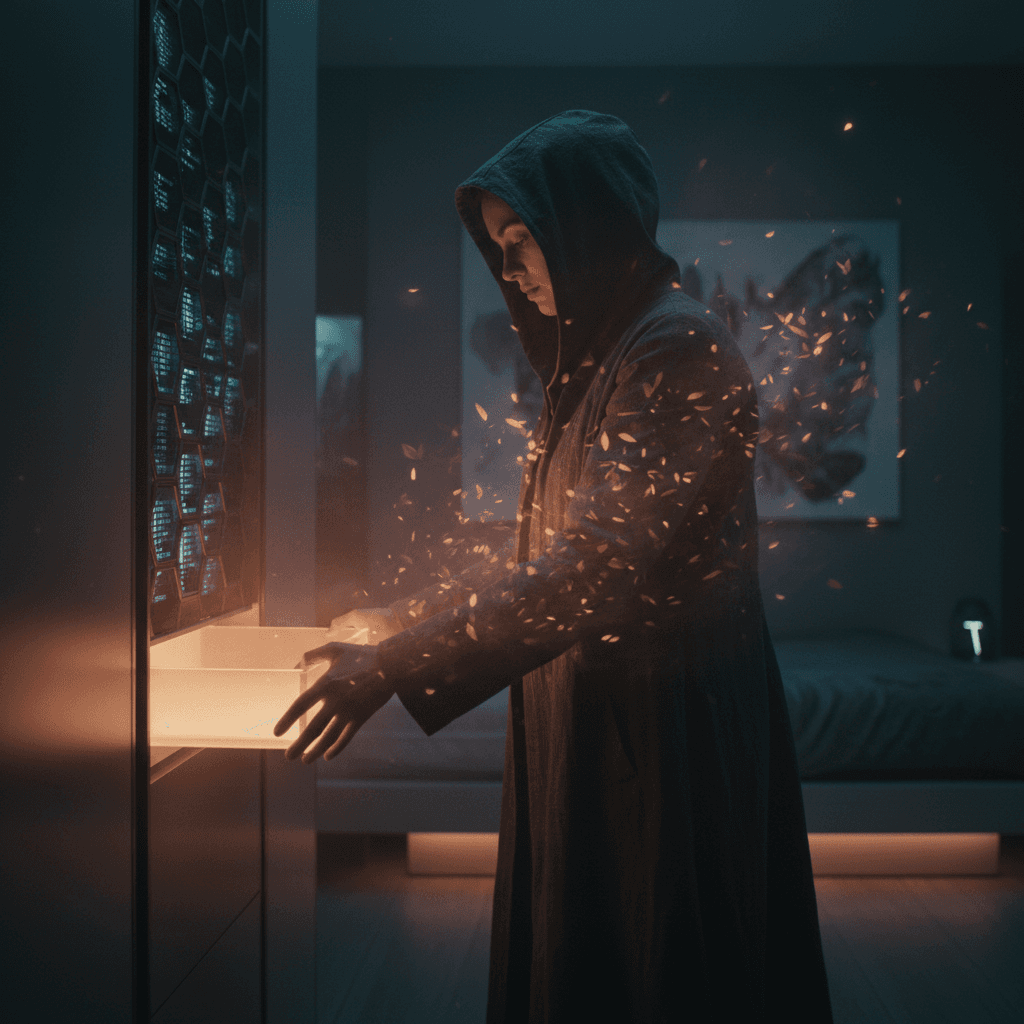

The drawer Theo opens by accident holds the smell of a pine forest that no longer exists, and neither of them says anything about it. The cartridge is cracked, an old breach, the resin gone synthetic-sharp at the edges. He slides the drawer shut with two fingers. Around them the grid hums, hundreds of sealed extinctions kept at precise cold.
I catalog him the way I catalog everyone. Compact frame. Hands that arrive at the gesture before the sentence does. He's been in the room nine minutes and has touched four surfaces, none of them me. The cold lives in the floor here, not the air. I feel it through my soles like data.
She holds still in a way he recognizes from people who measure for a living. He wants to tell her about the Tokyo car, the 2019 ambient he's been rebuilding from degraded plates — the specific hush of a train decelerating, the cough at the far end. He wants her to hear the difference between a reconstruction and a presence. Instead he says, *You're cold,* and the words land a half-beat behind his hand, which is already lifting toward her face.
His palm is warmer than the room. I let him. This is the part I am bad at — the letting. I spend my days mapping the topology of other people's grief for actuaries and hospice machines, and I have become so fluent in damage that I cannot feel opaque to anyone. He doesn't know mine yet. That is the entire appeal.
He lifts her hair without asking, and asking would have ruined it. There's the scar at her left temple, a pale pressure-mark from an interface model they stopped making. He doesn't ask why she kept it. He presses his mouth to it. Her breath changes — not a gasp, something quieter, a recalibration.
His lips on the scar. I had forgotten it could be a place and not a fact. People look at it and see the discontinued model, the lawsuits, the part of my history I wear by the temple. He kisses it like it's just skin that has been through something. My fingers find the back of his neck before I decide to move them. There — the pulse, fast, where the spine meets the skull.
Her hand at his nape. He thinks she is reading him. She is. He doesn't mind being read if she'll keep going. A zipper gives at her collar and stops halfway — on purpose, his or hers, neither knows. He flattens his hand against her sternum. Under it he counts: heartbeats, the old habit, the way he counts decay in an audio plate. Eighty-something and climbing.
His hand on my sternum, and then it stops. Not the hand — *him.* The whole forward motion of him goes still, the way a held note in a recording goes still before it decays. I close my eyes. Not to surrender. To record. I want to keep the exact stillness, the moment his body chose to stay instead of perform staying. The cold floor. The pine ghost. His hand counting something it would not tell me.
He keeps his palm against her sternum and feels her eyes close, and he thinks: *the scar.* He will carry the scar. The pale pressure of it against his lips, the fact that she let him near the part of herself she refused to revise. That is the thing. That is what he'll take out of this room into the dark.
—
Later they will both be asked, separately, by separate machines, for the same four minutes. The recordings will be laid side by side, offset by seconds, then drifting. The hum will match. The pine will match. The cold in the floor will match.
But the fixed point will not.
He gives them the scar — his mouth, her permission, the discontinued model warm under his lips.
She gives them his hands going still. Not the kiss. The stopping. The instant his body stopped translating and simply arrived, palm over the bone that keeps the heart, counting a number he would never say aloud, while she closed her eyes and held the only breath of the year she would choose to keep.
The same four minutes. Two people reaching across their own damage. Neither of them carrying the other's reason for staying.