
The rig required a living pulse to calibrate against, so every Thursday I held Davi's wrist while Su-Ah read the numbers that decided whether he had really felt what he was about to sell.
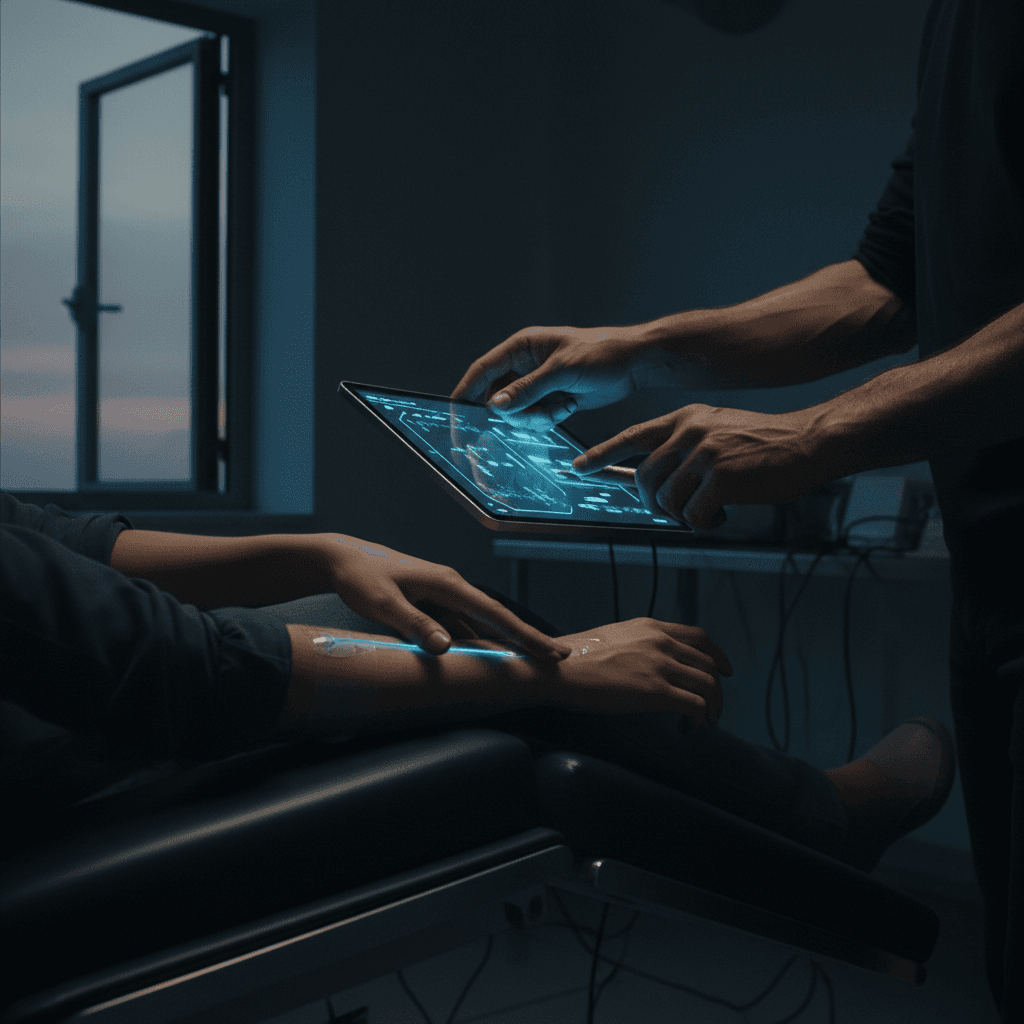
The procedure has a shape, and the shape does not change. Davi reclines in the cradle. I sit on his left, where the tremor lives, and press my unsteady hand flat to the armrest until it goes quiet. With the steady hand I find the radial artery a thumb's width below the heel of his palm. Su-Ah takes the reading station, her coat the same regulation gray as mine, her hands cold from the corridor. She warms them on the skin-temperature coffee neither of us has finished. Nobody comments on this. It is part of the shape.
The gel goes on his temples — engineered cool, designed to feel clinical, staying cold past the point physics allows. The attestation rig warms with its ozone smell and the 60-hertz hum that lives in my teeth by the second hour. The radiator ticks. The window that will not fully close admits a band of cold air across Davi's bared forearm, and the gooseflesh rises there in a line, and I read his pulse through it: sixty-one, even. A chipped-tooth smile when he catches me counting.
"Baseline's clean," Su-Ah says. "Run the source."
The source is the memory Davi means to sell. I am not supposed to watch it, only to feel whether his body agrees with what the rig claims he felt. My job is congruence. The numbers tell Su-Ah the story; my two fingers tell me the truth underneath the story, the way a pulse cannot lie about wanting.
The memory plays. His rate climbs to seventy-four, then settles. Warmth. A held wrist. Two people in gray coats and one window that will not close.
I have verified this signature before. Many times. I do the arithmetic the way Su-Ah taught me, before the fork, before we split a self badly enough that we kept the scar and not the rest: the memory under my fingers is this room. These chairs. Su-Ah's cold hands. My thumb on his pulse. He has been donating the ritual itself — selling strangers the sensation of being held by us — and buying back a faded copy each Thursday so he can be held again as if for the first time.
His pulse goes to eighty-one. He knows that I know.
"Ilse," Su-Ah says. Not the protocol cue. My name.
I do not move my hand. His wrist is warm where mine has warmed it, the gel cool on his temples, his breath fogging faint against my knuckles each time I lean to count. The window leaks gray dawn. The gooseflesh has not gone down. I feel the specific weight of his artery pushing against my fingertips — the small insistent fact of him, alive and choosing this — and Su-Ah watching the readout instead of our hands because watching the hands would be unbearable for all three of us.
The attestation field opens. It wants my signature. It wants me to certify that what Davi felt is congruent with what he is selling — to notarize the held wrist, to make the warmth a deed, transferable, true.
I take my hand off the pad. Not off his wrist. Off the rig.
"Ilse," Su-Ah says again, softer.
"It times out in ninety seconds," I tell her.
She looks at me. The scar on her jaw she refuses to edit catches the cold blue instrument light. She wants only to be remembered correctly by the two people who could verify her. She puts her cold hand over my flat one on the armrest — warm enough now — and does not reach for the station.
The counter runs down. Davi's pulse stays high and does not lie. None of us moves. The radiator ticks like something patient. Somewhere inside the rig's chassis a cooling fan stutters once, catches, goes on — a sound so ordinary I have never noticed it until now, until the silence it interrupts is the only thing any of us is protecting. The field expires, unrecorded; the memory stays unsold, unsigned, ours — the first and only copy.
His wrist is warm under my thumb, and I let it be warm without writing down how much.