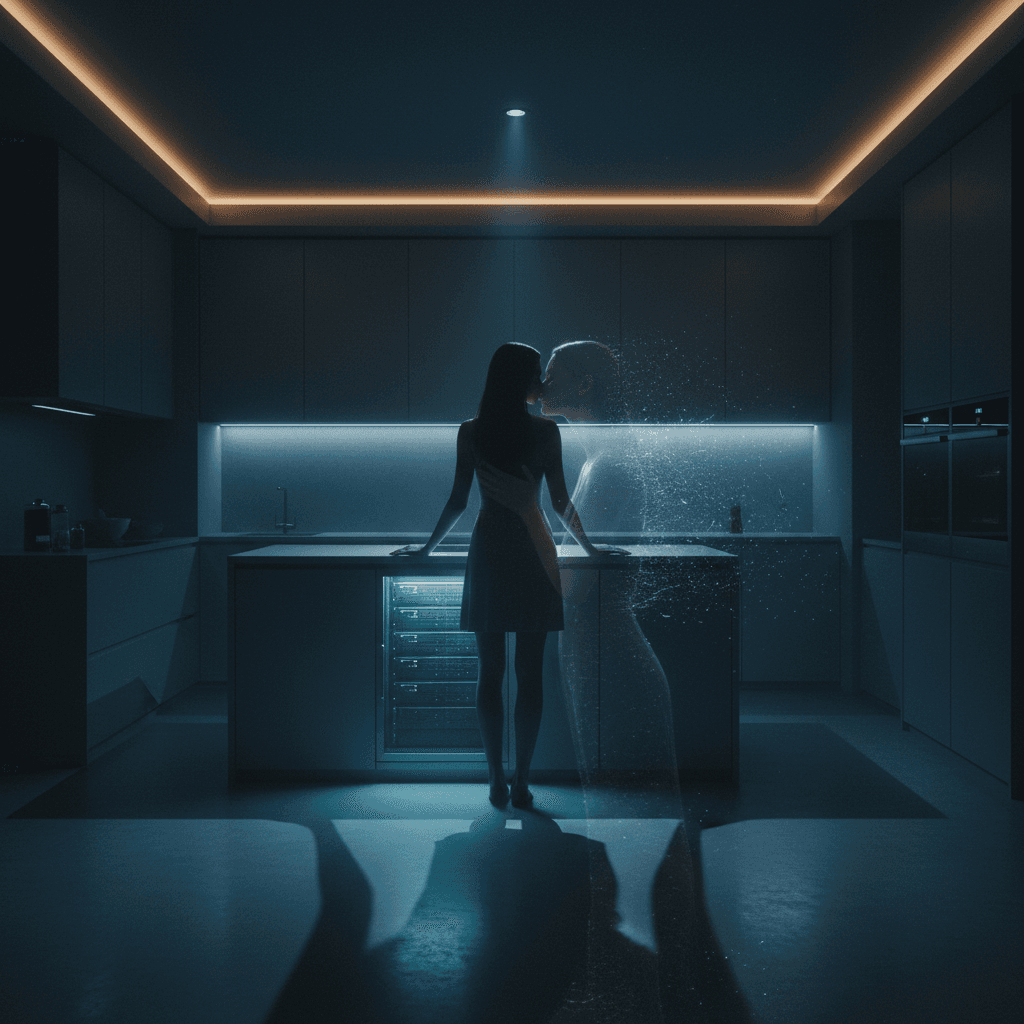

The kiss was already a memory by the time she reached the kitchen, which is how she knew it had actually happened. The other kind — the ones she mapped for grieving families — never receded. They sat exactly where they were placed.
The archive processor was cooling behind her, its hum dropping by quarter-tones. Rain came through the cracked window, warm off the concrete, and the amber strip light made the cold coffee on the counter look like something fermenting. She kept her back to him. There was no reason to. The decommissioned rig needed nothing from her hands.
Theo had not moved toward the door. She heard the small click of the port behind his ear when he turned his head — toward her, or toward the window, she didn't let herself check. She thought of his work: couples separated by oceans, by death rehearsed in advance. He spent his days calibrating how long a simulated hand should linger before it lifted. The exact latency that made absence feel like presence. The breath that arrived a beat late, the way real breath does.
He set his hand on the counter. Six inches from hers. She studied the ink bled into her own wrist, the open parenthesis of the scar she could feel but not see.
She understood then, with a slow vertigo, that she could not tell the difference. Whether the warmth at her back was his or something tuned to feel like his. Whether she had been met or only calibrated.
She did not turn around. Neither of them looked up. She left her hand where it was and waited to learn which of them would close the distance, or leave it.