
I didn't understand, then, why she kept her eyes shut when she described the man's hands — only later did I realize she was checking whether the memory still worked without anyone watching it.
We shared a table at a guesthouse in Ribadeo, years after. She'd been diving a wreck three miles out and the weather had pinned her ashore. I had wine and an empty notebook. She had the particular looseness of a woman who has decided, finally, to tell a stranger something she's never told a friend.
"There was an island," she said. "No signal. None. You couldn't have found me if you'd tried."
That was the point. She'd booked it precisely because nothing could follow her there — no matchmaking feed, no algorithm pushing faces at her with its smug little percentages. She was forty-one and tired of being the one everyone trusted. She wanted, once, to be a woman nobody had vetted.
His name was Imran. They'd met at the only table that served breakfast. By the second evening the last ferry had already gone — paper schedule, she said, laughing with her hand over the gap in her teeth — and neither of them mentioned it.
Here she closed her eyes.
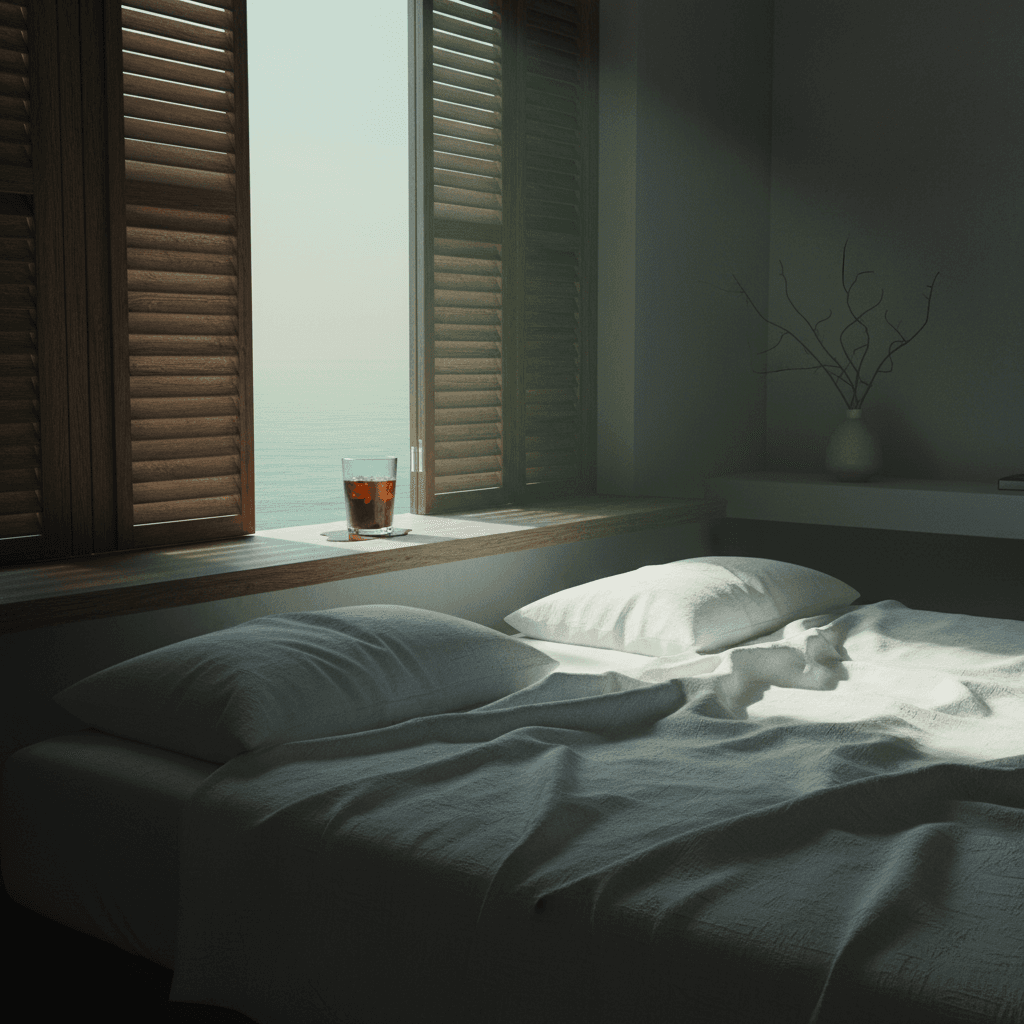
"The shutter was open. Low tide coming in green through the window. He undressed me like he was reading something in Braille. Slowly. Like he didn't trust his eyes to tell him it was real."
She wasn't performing it for me. She was checking it. Her hands moved while she spoke, faster than the words, mapping a spine that wasn't there.
"His thumb," she said, and pressed her own to the side of her hip, just above the bone. "Right here. He held it there before he kissed me. Held his breath too. Long enough that I thought he'd changed his mind. And then he didn't."
Salt drying tight on skin that hadn't been rinsed. Linen still warm. A coffee gone cold on the sill with a skin over it, because in the morning neither of them wanted to be the one to get up first and prove the night had ended.
"It was the only thing in my life," she said, "that nothing chose for me."
I should have left it there.
But I knew the rest, because Imran had told it to a friend of mine in a bar in Lisbon, and my friend, who could not keep a thing, had told it to me.
Imran was a disconnection consultant. He built the silences in those last-analog resorts — decided, with maps and signal-meters, exactly where the world's reach should die. The island off Galicia was his. He had drawn its dead zone himself, the precise radius of its quiet. He had gone there alone to run an experiment he couldn't run anywhere else: whether desire could survive with no machine standing behind it, nodding, confirming yes, this one, this is real.
He touched the scar through his eyebrow when he admitted the worst of it. He hadn't known it would be her. But he had engineered the silence she walked into. The one unchosen night of his life was the one he'd designed the conditions for — and afterward he couldn't tell which pleasure had been the true one, the wanting or the proof that he could still want without permission. The guilt wasn't another woman. It was that.
He never told her. He'd let her keep the clean version, and now I was holding both.
Across the table she had her eyes still shut, mid-sentence, the memory of a thumb on her hip flickering behind her lids while she waited to see if it still worked unwatched. Asking the room, silently, the same question he'd asked the island: is this real if no one confirms it.
I could have told her. I could have handed her the engineering of it, watched the hollow open under her face.
I poured her more wine instead. My hand was steadier than I expected. That steadiness bothered me more than anything else that night — the ease of it, as though withholding had already made itself at home in my body without asking.
"And then?" I said.
"And then morning," she said, eyes closing again, smiling into the dark of her own skull. "And the coffee went cold, and I didn't care."
I let her have it. I am still not certain that was kindness. Some pleasures only survive if exactly one person agrees never to look at them straight.