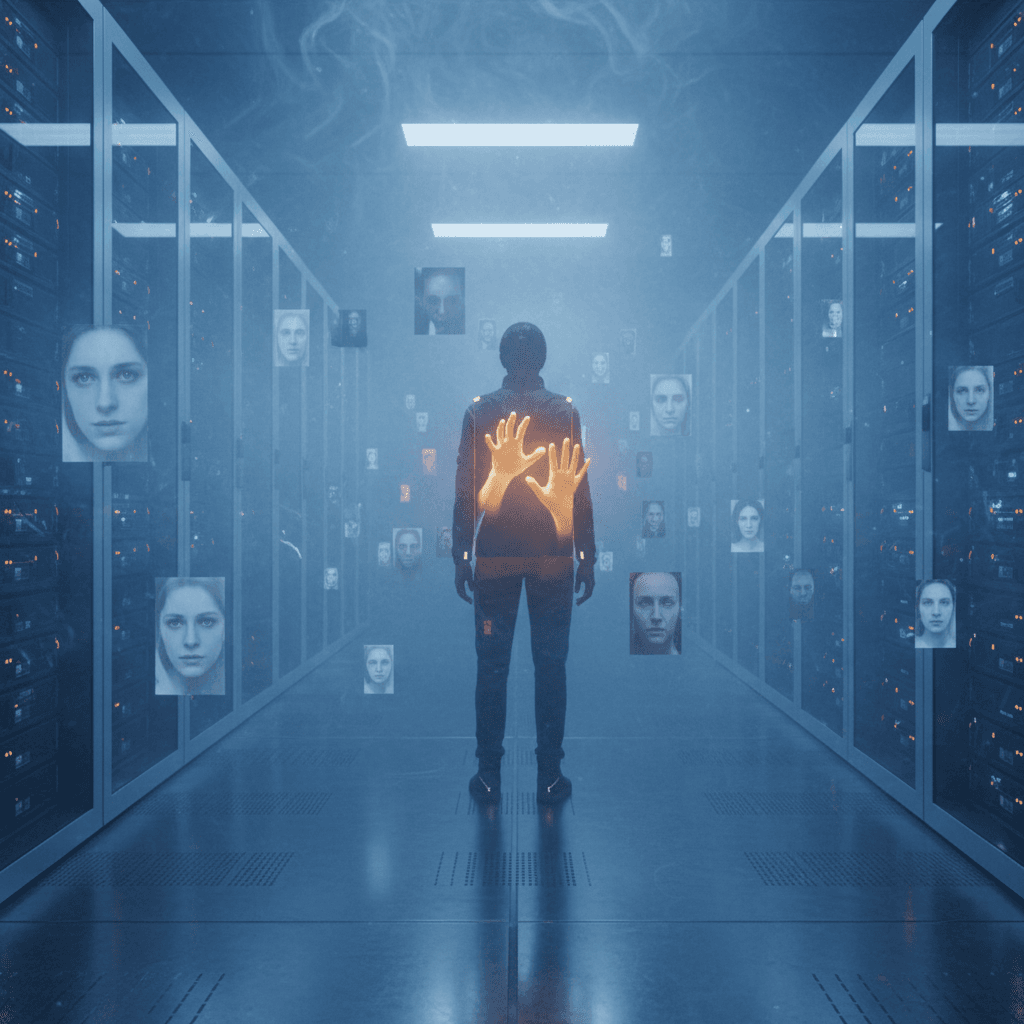

The first time I appeared in a dead woman's memory, I assumed it was a rendering artifact.
Mrs. Achebe had been archived on a Tuesday. Standard intake — her family paid for full-spectrum preservation, which means we reconstruct everything the cortical scan captures: sensory impressions, emotional tags, the half-formed images that flicker behind language. I was running quality review on her wedding reception, 2043, a garden in Lagos with jasmine and red tablecloths, when I noticed the woman sitting at the far table.
She had my face.
Not precisely — the resolution degrades at the periphery of a memory, and the archive fills gaps with proximate data. Faces that the deceased never looked at directly get reconstructed from whatever the system has on hand. But this was specific: my jawline, my hands, the way I hold a glass with my ring finger extended.
I flagged it and moved on. Proximity contamination. The manual says it happens when archivists work long shifts and their ambient neural signature bleeds into the reconstruction engine. Take a break. Drink water. It will resolve.
---
The second time, Kai noticed too.
We were co-processing a retired cellist — massive archive, sixty years of muscle memory alone — and Kai pulled me over to his station without saying anything. Just turned his monitor so I could see.
The cellist's memory: a summer night, a rooftop in Thessaloniki, 2061. Someone is playing a recording of Jacqueline du Pré, and two people are dancing slowly in the far corner of the frame. One of them is me. The other is Kai.
We've worked adjacent desks for eight months. He brings oolong tea in a thermos with a cracked lid. I know the sound of his typing — arrhythmic, like he's always mid-thought. We have never danced. We have never been to Thessaloniki. And yet there we were, his hand at the small of my back, my head tilted toward his shoulder, rendered in the amber grain of a dead man's happiest evening.
"The manual says proximity contamination," I said.
"The manual says it happens with *one* archivist. Not two. Not together." He zoomed in. The detail was remarkable — the system had rendered the exact pattern of the freckles on my wrist. It had given Kai the scar above his eyebrow, the one he says is from a bicycle but I suspect is from something he doesn't discuss.
"It's using us," I said.
"It's using us as a *couple*."
---
We started checking. The Achebe wedding — I was there, yes, but so was Kai, two tables over, watching me. The cellist's rooftop. A retired teacher's memory of a rainy afternoon in a bookshop — Kai reaching past me for a volume on the high shelf, his chest almost touching my shoulder. An aviator's memory of a train platform in Kyoto, autumn, and two people standing close enough to share an umbrella but not sharing one.
Fourteen archives. Seven weeks of processing. And in every single one, the algorithm had found a gap in a stranger's memory and filled it with the two of us, together, in various stages of almost.
"I think," Kai said carefully, "that the system reads more than neural proximity."
He was not looking at his screen. He was looking at me.
"What else would it read?"
"Attention. Duration. Where your eyes rest when you're not working. The system is designed to reconstruct what love looks like in degraded memory, and it keeps pulling from the same source."
The processing lab was very quiet. The archive hummed its low, patient hum, cataloguing the inner lives of people who would never add to them again.
"How long?" I asked.
"How long have I been watching you?" He set down his thermos. The crack in the lid caught the fluorescent light. "Since about a week after you started. You?"
I thought about lying. But we were sitting in a room full of dead people's truths, and it seemed wrong to add a living one.
"About the same."
He smiled. Small, private, not performed. The kind of expression the archive would need sixty years of data to render correctly.
"The algorithm isn't wrong," he said. "It's just impatient."
---
We archived Mrs. Achebe's wedding properly on the second pass. No proximity contamination. Clean reconstruction, every face belonging to someone she actually knew.
But I saved the first version — the one with me at the far table, holding a glass with my ring finger extended, watching the dance floor where Kai was already waiting.
Some errors are worth keeping.