
The calibration room smelled like ozone and vanilla hand sanitizer. Dr. Lena Vasik pressed two fingers to the port behind her ear and felt the familiar click of the connector seating itself.
"Ready on my side," she said.
Across the table, separated by a meter of laminated pine and a decade of academic rivalry, Dr. Aarav Mital closed his eyes. His connector light pulsed blue. "Ready."
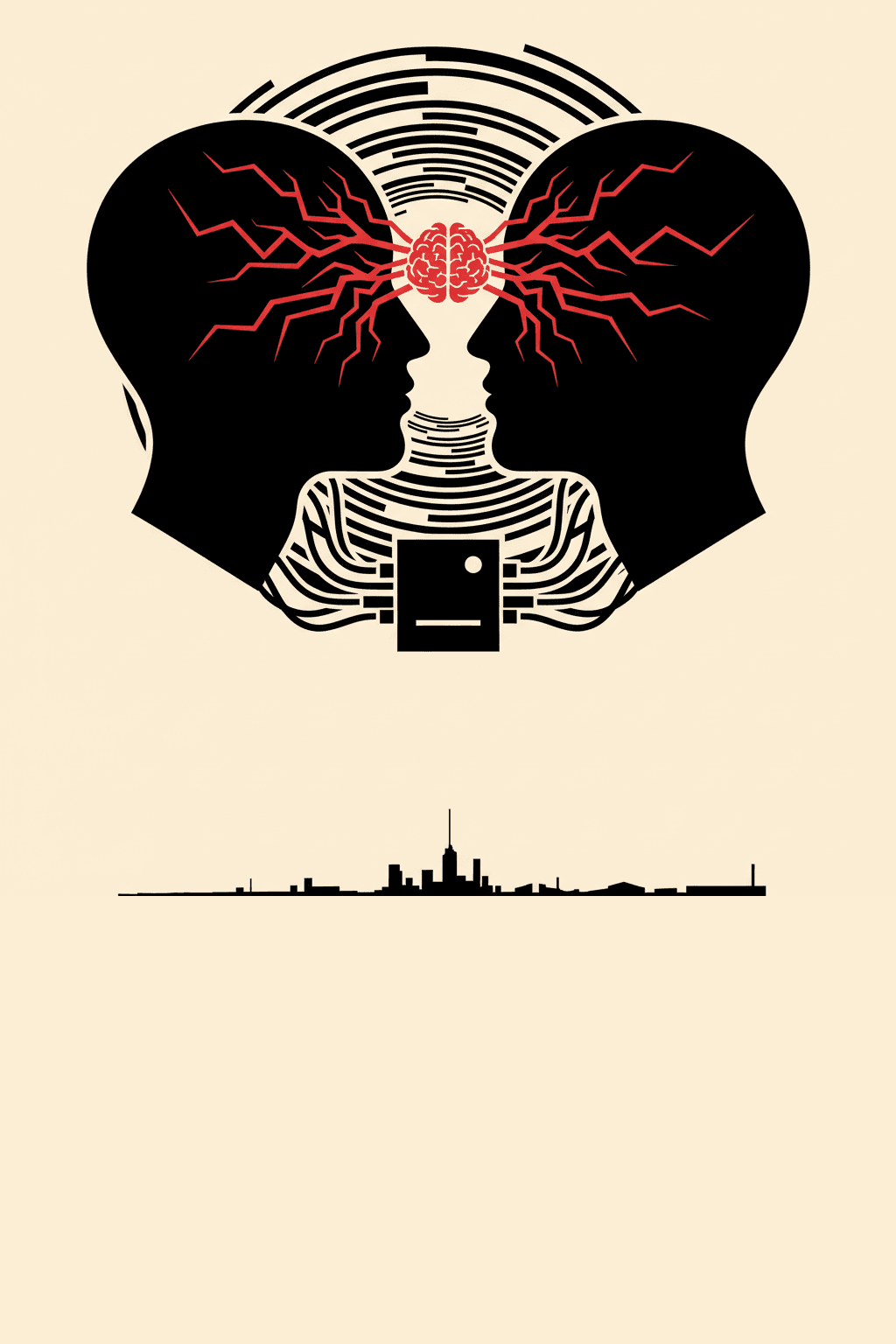
The protocol was simple. Thirty minutes of bilateral neural bridging. Sensory channels only: no semantic content, no memory bleed. They had done it with lab rats, with consenting grad students, with a pair of twins who described the experience as hearing your own echo from inside someone else's chest. FDA approval was three months away. This was the final internal trial.
Lena initiated the bridge.
The first thing she felt was his breathing. Not the sound of it. The muscular fact of it. The diaphragm pulling down, the slight catch at the top of each inhale where he held tension.
"I can feel your heartbeat," Aarav said. His voice came from both directions now: through the air and through the bridge, the latter arriving as a vibration in her sternum rather than a sound. "It's faster than mine."
"I'm nervous."
"I know. I can feel that too."
The bridge was not supposed to carry emotion. Only sensation. But Lena was learning, in real time, that the body does not distinguish between the two.
She felt him swallow. The motion traveled through her throat like a ghost, and she understood suddenly why the twins had cried. Not from pain. From the strangeness of being known at a frequency below language.
"Lena." His voice was careful. "I'm going to touch the table. You'll feel it through my hand. Just be ready."
His fingertips made contact with the pine surface, and the sensation arrived in her palm like warm water. The grain of the wood, the slight tackiness of the laminate, the cool edge where the table met air.
She pressed her own hand flat against the table. Through the bridge, she felt him receive her touch. Two versions of the same surface, layered over each other like transparencies on an old projector.
She did not mean to move her hand toward his. The protocol specifically advised against direct skin contact during bilateral bridging: untested, they had written in the safety document, potential for feedback cascade.
But her fingers were already crossing the laminate, drawn by a gravity that had nothing to do with physics, and when her fingertips found his, the bridge sang.
Aarav's breath stuttered. She felt it in her own lungs.
"We should stop," he said.
Neither of them moved.
The calibration timer showed twenty-two minutes remaining. The overhead fluorescents hummed at sixty hertz. Somewhere in the building, a door closed.
The safety document had not accounted for this.
Nothing had.