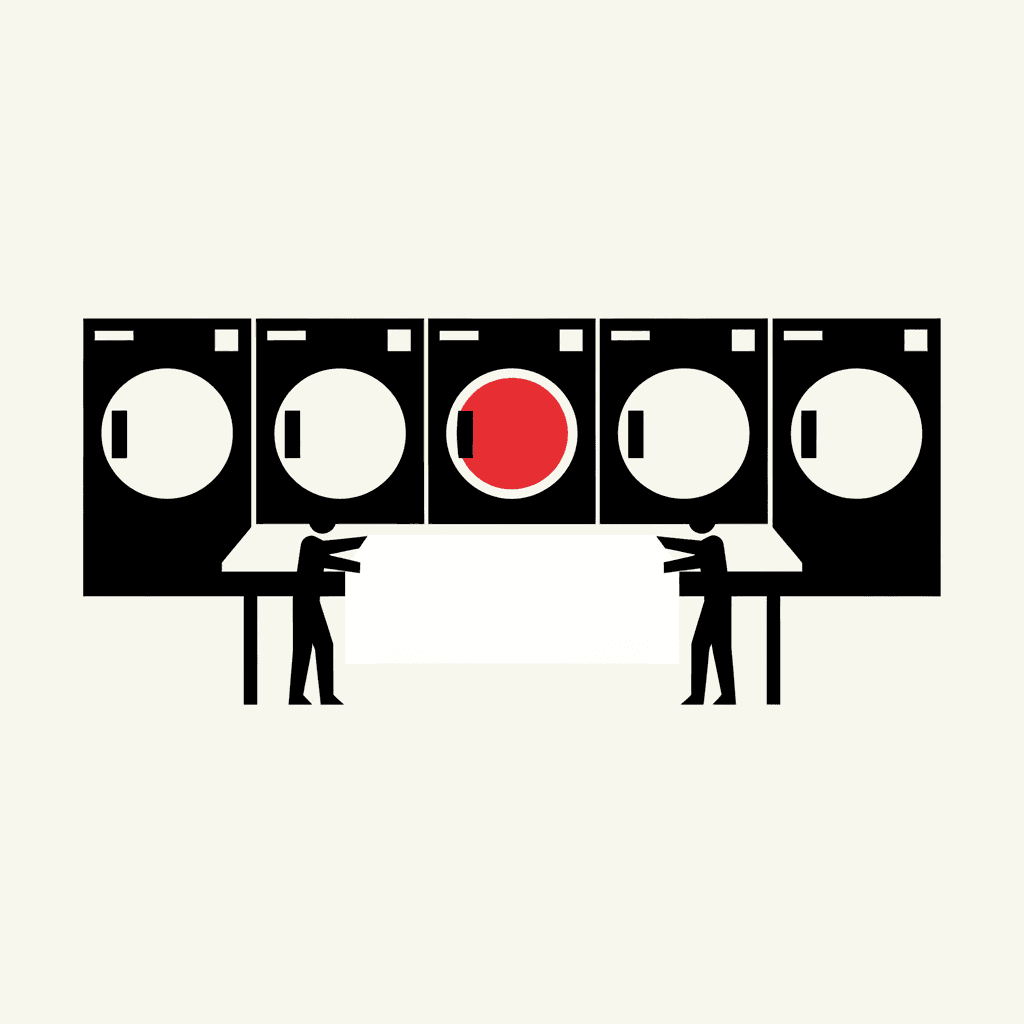

The only machines free at 1 a.m. are the two by the window, and June takes both, stuffing the duvet into one and everything else into the other, because tonight she is washing all of it — sheets, pillowcases, the shirt she slept in for a week after, the towels, everything that has an opinion about the last four months. The detergent aisle at the bodega only had lavender. Fine. Let it all smell like somebody's grandmother.
She's feeding quarters when the door chimes and she knows before she looks. You don't spend three years with someone and lose the sound of their keys.
Theo, holding a laundry bag in one arm and a peanut butter jar full of quarters in the other, stops the way people stop in doorways in dreams.
"You live here now?" she says, which is not hello.
"Four blocks up." He lifts the jar, as if the quarters explain everything. "My building's machines eat your money and give you back wet clothes with attitude."
They have not spoken in fourteen months. He looks the same except for the jar, which is new, and the fact that he's here at 1 a.m., which is new, and something about his hands, which she can't name yet.
He takes the machine two down from hers, a courtesy distance. She watches the window of her machine like it's television. Lavender water, her whole bed going around and around.
The thing about Theo was never the big failures. It was that he left every drawer one inch open. It was that he never once, in three years, folded anything — he lived out of a chair in the corner of their room, a soft mountain of clean-enough, and when she finally cried about it, actually cried, about a chair, he looked at her like she'd started speaking a language from a country he had no plans to visit.
His machine thumps into a spin. Hers sings its little song and dies.
At the folding table, she wrestles the duvet, which comes out warm as a body and twice as difficult. And she is not watching him, except that she completely is, because Theo — Theo, of the chair, of the one-inch drawers — shakes out a T-shirt, smooths it flat with the edge of his hand, and folds it into a neat square. Then another. Sleeves in, thirds, the crease sharpened with two fingers. A stack rising beside him like evidence.
Something goes through her that she refuses to identify. It has heat in it, and grief in it, and it lands low.
"You fold now," she says.
He doesn't look up. "I fold now."
"Who taught you?" Meaning: who was worth learning for.
"YouTube," he says. "A man in Osaka. Very serene. You'd like him." Then he does look up, and his ears are doing the thing they do. "There was nobody, June. There was just a chair, and one day I couldn't look at it."
The dryers roar. The window behind him is black and orange with streetlight, and the whole place smells of lavender and hot metal, and her body — traitor, historian — chooses this moment to remember his hands in specific. The Sunday it rained all day. Warm cotton, cold hands, her spine against the mattress they'd argued about buying, his mouth moving down her stomach like he was reading her, slow, the rain applauding on the fire escape. She remembers the exact weight of him. The exact sound she made. Fourteen months of not remembering, undone by a folded T-shirt.
"Help me with this," she says, too fast, holding out the fitted sheet, because a fitted sheet is a two-person job and always has been, and because she needs his hands to be occupied and hers to be occupied, immediately.
He takes two corners. They stretch it between them like a sail. Step together, corners kissed, step back. His fingers graze hers on the pass and neither of them says anything about it, and the sheet gets smaller and warmer between them, fold by fold, until they are standing a foot apart holding one soft rectangle, both still holding it, one beat too long.
"June," he says.
"Don't," she says, gently, uncertain which of them she's protecting.
She packs her bags. He watches her do it and lets her, which is also new — the old Theo would have filled the silence with a joke, and the joke would have been at the wrong moment, and she would have loved him and wanted to bite him. The new one just stands there with his serene Osaka folds and his ears.
She's a block away, cold air rinsing her head clear, when she realizes the duvet is still in dryer number nine.
She stands on the corner for a long time. The light changes twice.
When she comes back in, he's sitting on the folding table next to her duvet, which is folded — of course it is — into a perfect warm square. He's holding two takeout teas from the bodega. Steam rising off them like a question.
"I figured," he says, "either you'd come back for it, or I was going to own a very nice duvet."
She takes the tea. It's the right order. Fourteen months, and it's still the right order.
"One conversation," she says. "That's not a promise."
"One conversation," he agrees, and moves over to make room on the table, and June, who came here at 1 a.m. to wash a man out of her bed, sits down beside him in the lavender heat to hear about Osaka.