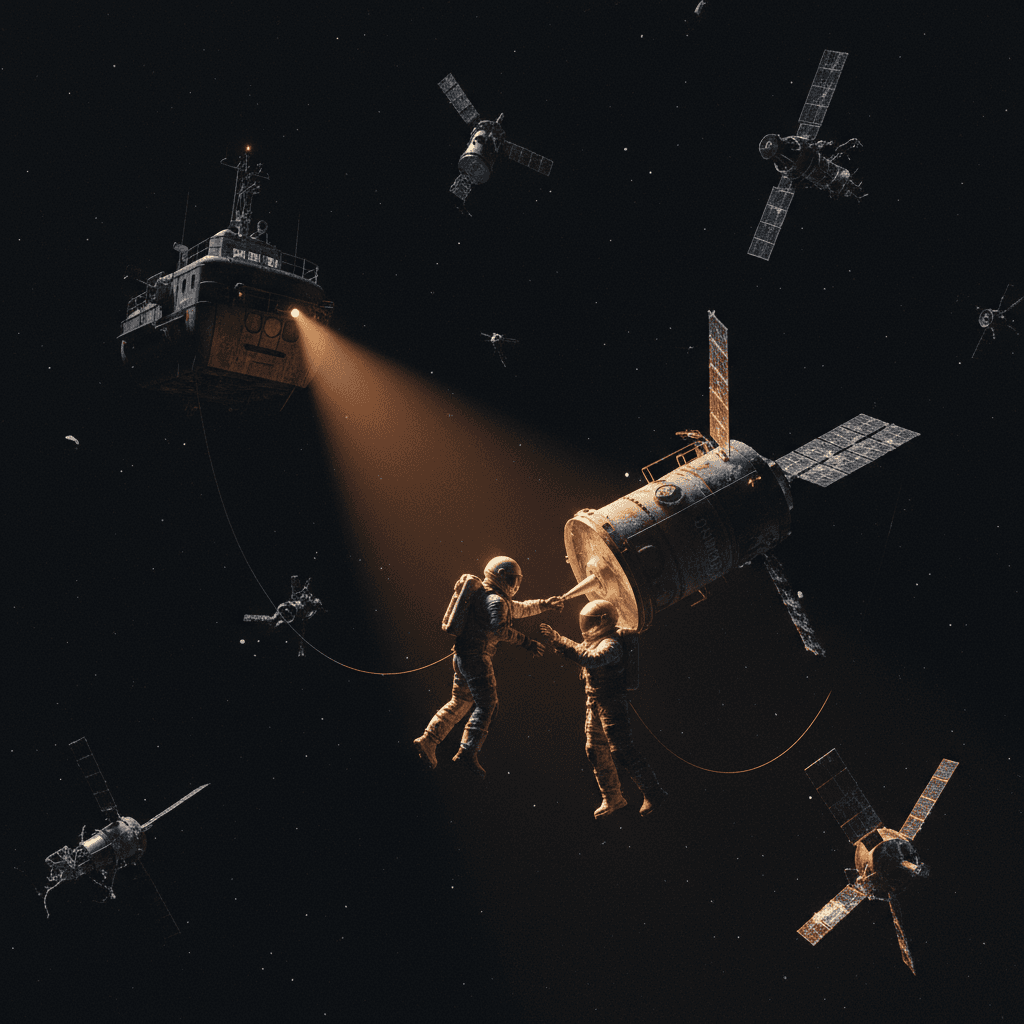

The satellite was a Kuiper-series relay from 2031, tumbling at half a degree per second through a graveyard orbit nobody had cleaned in fifteen years. Miri spotted it on the LIDAR while I was patching the portside grapple arm.
"Intact shell," she said over the comm. "Good aluminum. Probably sixty kilos of recoverable gallium arsenide in the solar array."
"Worth the fuel?"
"Worth the fuel."
We suited up. The tether between us ran twelve meters, thin as a pencil, rated to five thousand kilos of tensile load. I've been clipped to Miri Tekawa for eleven months of salvage runs, and in that time I've learned to read her by the tether — the way it goes taut when she's focused, loose when she's drifting, the subtle vibration when she laughs.
She's from Tuvalu. Was from Tuvalu. The distinction matters to her in ways I've learned not to paraphrase.
---
We matched rotation with the satellite and Miri cut the first panel free while I held the frame steady. Standard work. Quiet except for breathing and the occasional click of her cutting tool. The Earth below us was the Pacific, blue and featureless, and I did not mention this because I have learned that too.
Inside the relay housing, the main board was corroded but the memory module was sealed — military-grade potting compound, airtight. Miri pried it loose and turned it over in her gloves.
"Data cache," she said. "Undelivered packet queue."
"Leave it. We're after the gallium."
"It's from 2031."
She didn't say anything else. She didn't have to. 2031 was the year the water took Funafuti. The year her mother sent a message that arrived three weeks late because the Pacific relay network was already failing, satellites overwhelmed by a million people trying to say goodbye to places that were becoming ocean.
"Bring it in," I said.
---
We cracked the cache in the workshop, helmets off, the smell of recycled air and solder. The module held forty-seven thousand undelivered messages. Texts, mostly. Some voice. A handful of video compressed to postage stamps.
Most were mundane. Shipping confirmations. Calendar reminders for meetings that happened or didn't. A recipe for banana bread sent from Auckland to Suva that never arrived.
Then Miri found the cluster from the Pacific networks. November 2031. Hundreds of messages routed through this exact satellite during the week the relay failed. People writing to people on islands that were, at that moment, going under.
She read them in silence. I watched her face and knew I shouldn't, and watched anyway.
One was from a girl — maybe fourteen, judging by the syntax — to someone named Lani. It said: *The water is at the church steps. Mum says we go to the roof tonight. Are you on the boat already? I can see the boat from here. Wave so I know which one.*
Miri set the tablet down. She pressed her fingers against her eyes. The workshop was very quiet.
"I can finish this," I said. "You don't have to—"
"I want to." Her voice was even. Practiced. "Someone should read them."
---
We spent four hours in that cache. Miri read every Pacific message. I sorted the rest, filing metadata, logging coordinates for the archive service that probably wouldn't collect them. Our shoulders touched in the narrow workshop, space suits peeled to the waist, and at some point her hand found my knee and stayed there, her thumb tracing a slow absent line along the seam of my thermal layer.
I covered her hand with mine. She didn't pull away. She turned her palm up and laced her fingers through mine and held on the way you hold a tether — not because you'll fall, but because the holding is the point.
"My mother sent a message that week," she said. "I got it. Late, but I got it." A pause. "I always wondered about the ones that didn't make it through."
I brought her hand to my mouth and pressed my lips to her knuckles. She closed her eyes.
"Forty-seven thousand messages," she said. "Sitting up here for twenty-three years while the world moved on."
"We found them."
"We found them."
Outside the porthole, the Pacific turned slowly beneath us, blue and whole and holding its secrets under a calm surface. Miri leaned into me. I leaned back.
The tether between our suits hung slack on the wall rack, twelve meters of line that had kept us connected through eleven months of salvage runs, and I thought: *some things are only worth recovering if someone is there to receive them.*