
The protocol exists because of what happened on Enceladus.
Four years before I transferred to Europa Station, the crew at Enceladus Deep lost two permanent staff to acute depressive episodes after their rotating partners shipped home. One walked into an airlock anteroom and sat there for eleven hours. The other stopped eating. The psych review found that cross-rotation attachments produced grief responses comparable to bereavement, compounded by the knowledge that the absent person was alive, reachable by comm, and simply *elsewhere* — 628 million kilometers of elsewhere, in Callisto Station's case.
The Rotation Protocol was implemented across all outer-system installations within six months. Permanent crew and rotating researchers maintain professional boundaries. Socializing is permitted. Intimacy is not. The language in the handbook is clinical: *emotional investment calibrated to the duration of shared assignment.*
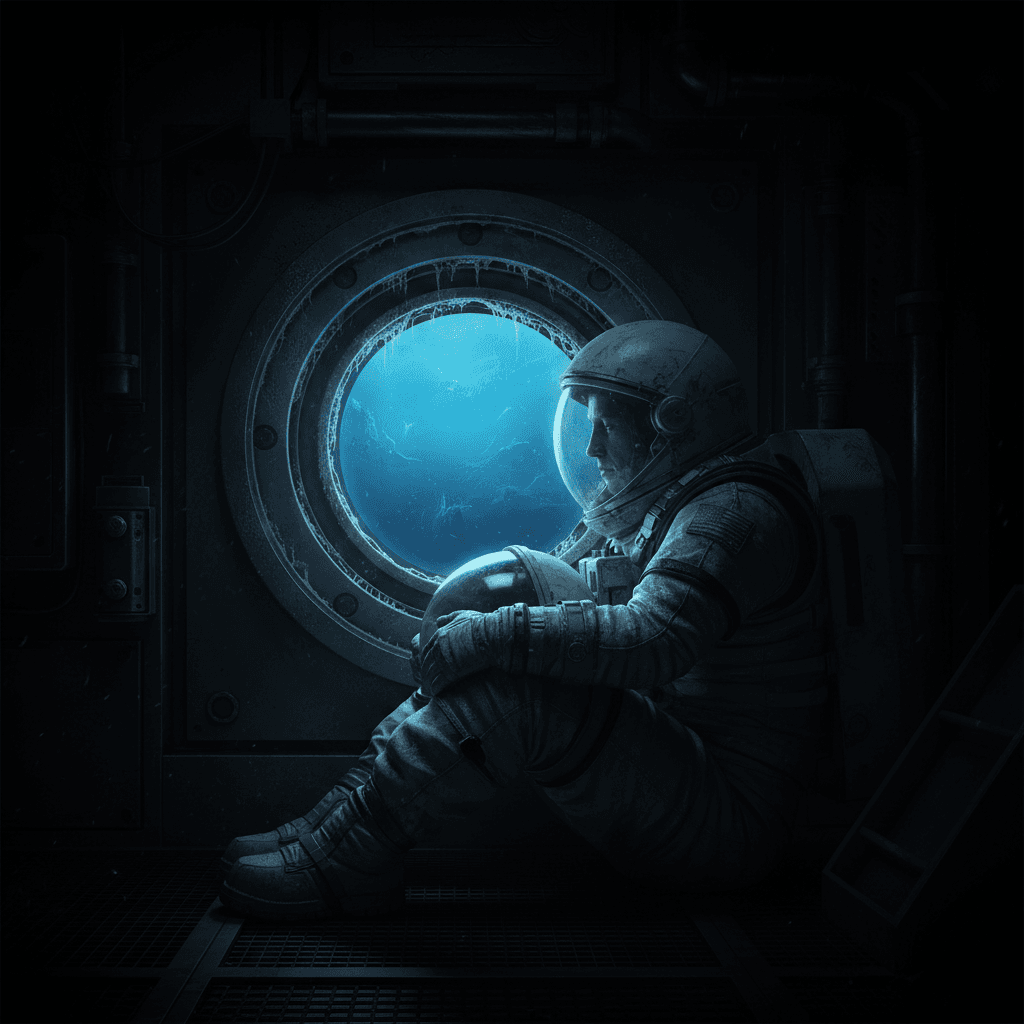
I've been permanent staff at Europa Station for three years. I maintain the thermal exchangers that keep the ice above us from re-freezing around the hull. I know every groan this station makes, every pressure shift, every subtle change in the way the water moves outside the observation ports. I chose permanence because I'm good at it. I don't leave. Things don't leave me.
Then Ryn Vasquez arrived on the autumn rotation, and the protocol became a different kind of problem.
---
She's a microbiologist studying the chemosynthetic colonies near the thermal vents — the organisms that might, if the grant committees stay patient, redefine what we mean by *alive.* She works long hours in the wet lab, comes to the mess hall smelling of sulfur compounds and autoclave steam, and reads journal articles on her tablet with her chin propped on her fist and her lips moving slightly, which I've decided is the most distracting thing a person can do in a confined underwater habitat on a frozen moon.
I didn't speak to her for the first three weeks. Professional courtesy. Rotation Protocol. The healthy management of proximity in closed environments.
Then the exchanger on B-deck seized at 0200, and she was the only other person awake, and she held the bypass valve open with both hands while I re-seated the coupling, and when the system caught and the steam cleared she looked at me through wet hair and fog and said, "You do this alone every time?" and I said, "There's a protocol about who helps," and she said, "That's not what I asked."
---
We started finding each other. Not dramatically — the station is small, and intention is easy to disguise as coincidence. She'd be in the observation lounge when I ran my evening check on the exterior sensors. I'd pass through the wet lab corridor on my way to the exchanger room, which is not on the way to the exchanger room. We talked about the vent colonies, about thermal dynamics, about the sound the ice makes at 0300 when the tidal flexing from Jupiter peaks and the whole station shifts two centimeters starboard.
One hundred and seven days into her rotation. Seventy-three remaining.
"I'm not going to pretend," she said one night in the observation lounge, the exterior floods illuminating the ice above us in pale blue columns. "I know what the protocol says, and I know why it says it. And I'm telling you that I'm choosing this anyway."
"You leave in seventy-three days."
"I know."
"The last crew that did this—"
"I know. But they didn't get to choose. The protocol decided for them, and the grief was about the loss of agency as much as the loss of the person." She was sitting close enough that I could feel the warmth of her through the station's chill. "I'm choosing you with full knowledge. That's different."
I wanted to argue. The protocol is evidence-based. The grief is real. But she was sitting in the blue light with sulfur still under her fingernails and her mouth set in the particular way it sets when she's made a decision, and I thought about three years of permanence, three years of not leaving and not being left, and I realized the protocol hadn't protected me from grief. It had just replaced it with absence.
"Seventy-three days," I said.
"Make them count."
---
We made them count.
I won't catalogue every night — some things resist narration, and the specifics belong to the narrow bunk in my quarters, to the sound of the water outside the hull, to the way her hands learned the topography of my body with the same focused attention she gave her vent colonies. What I'll say is that she tasted like recycled air and sulfur and intention, and when she pressed her forehead to mine in the dark and said *stay, stay, stay* I understood that she meant it as a present-tense verb, not a request about the future.
We had seventy-three nights. We used them.
---
She ships home Tuesday. The transport is already docked at the surface relay, waiting for the ice elevator to cycle.
The protocol says I should be devastated. The Enceladus data says the next six months will be a controlled demolition of my equilibrium. The psych handbook says *emotional investment calibrated to the duration of shared assignment,* and ours was not calibrated at all.
But this morning Ryn left something on my workbench — a sealed sample vial from her lab, inside it a single chemosynthetic organism, pale and luminous, suspended in vent fluid. The kind of thing that redefines *alive.*
The note said: *It grows in the dark. It doesn't need sunlight. It just needs heat. Sound familiar?*
I put it on the shelf beside the thermal exchanger readouts, where it glows faintly in the station's perpetual twilight, alive in a way that shouldn't be possible this far from the sun.
Seventy-three days. Sixty-two of them I'll keep. The rest I'll carry.
The protocol was right about the grief. It was wrong about whether the grief was worth it.