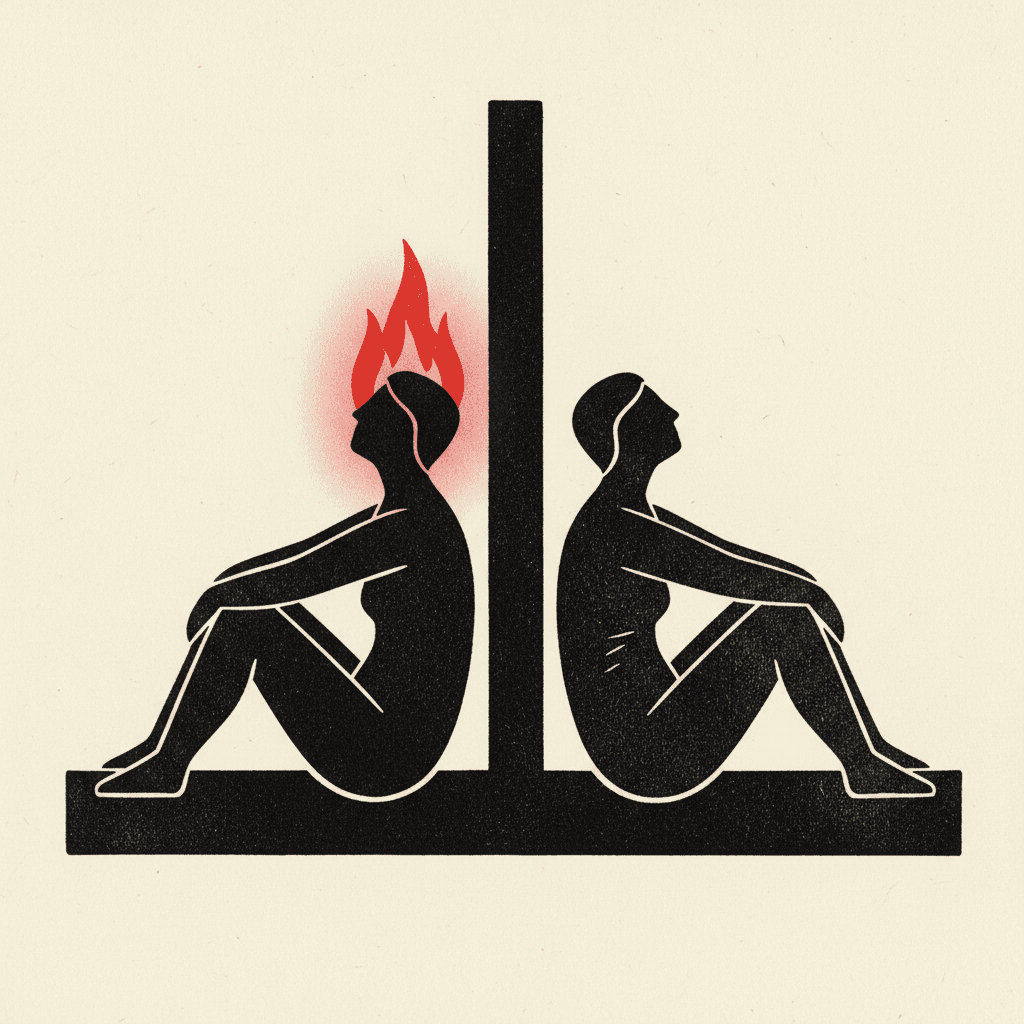

The wall between 4B and 4C is old enough to have opinions, and through it, for a year and a month, Nora has assembled a man out of sounds.
Kettle at 6:40, weekdays, even in summer, which means he drinks something hot regardless of weather — a person of ritual. Guitar on Sunday afternoons, the same progression worked at and worked at, a hard chord change he misses, misses, and then one Sunday in October didn't miss, and she'd looked up from her soup alone in her kitchen and said, out loud, "There you go," like a lunatic.
She knows the cabinet that sticks, the two-stage thunk of his boots coming off, eleven-ish. She knows he talks on the phone to someone he loves on Thursdays, voice all warmth through the plaster, words dissolved, tune intact — mother, she's decided. She knows that in the spring there was a woman's laugh for six weekends, and then a fight rendered in bass notes, and then some crying, his, brief, twice. She'd stood with her palm flat on the wall like an idiot that night, a foot of plaster and framing between her hand and a stranger's bad hour.
She knows his name is Theo James on the mailbox but everyone calls him nothing because nobody in this building talks — that's the covenant. You live a foot apart and you nod at the recycling bins.
What she does not know is his face beyond the blurred nod of it, or what the hot drink is, or who the progression is for. A year of intimacy with a rumor.
The blackout comes on a Tuesday in August, at 9:40 p.m., the whole block going down at once — not a flicker but a guillotine, her laptop dying, the refrigerator's hum revealing itself by leaving, the sudden enormous dark of a city with its lid off. Somewhere below, a whoop; a dog; then a silence so complete she can hear her own pulse.
And through the wall: a chair pushed back. Boots — no. Bare feet.
She finds the candles her mother made her buy. In the stairwell there are voices, the building shaken out of its covenant by the dark, and she goes because her apartment is ninety degrees and the dark makes it feel smaller, and because — fine. Because the feet stopped at his door, and his door is next to hers.
He's on the landing with a candle stuck in a jam jar, and he is both exactly and nothing like the man she built. Younger around the eyes. A white T-shirt gone soft with washing. Guitar calluses, she notes, on the hand holding the jar — one mystery confirmed against the plaster record.
"4C," he says. The candle does something good and terrible to his face.
"4B," she says.
"I know," he says, and then looks like a man who has stepped on a rake. "I mean — the wall. You hear things. Not — I don't listen —"
"You have your kettle at six-forty," she says, taking pity, or the opposite of pity. "Every day. What is it?"
He stares at her. Somewhere downstairs a door slams, someone laughs, the building talking to itself in the dark.
"Genmaicha," he says. "The toasty one. My mum sends it." A beat. "Thursdays," he adds, helplessly, confirming the other file, and something in her chest goes over sideways.
It should end there. Nod at the bins. But the stairwell is airless and her apartment is ninety degrees and his, he says, has the cross-breeze, corner unit, and there's a bottle of wine his brother left that's warm now but so is everything — and this is how Nora ends up on the floor of 4C at ten p.m. in a blackout, her back against his sofa, learning the room she has heard for a year. There's the sticking cabinet. There's the guitar, an old Yamaha with a sticker half picked off. The window over the street is open and the city is dark and talkative below, sirens far off, someone playing music from a car, and the candle in the jam jar sits between them on the floorboards making its small warm country.
The wine is bad and warm. Neither of them mentions it. They talk with the particular velocity of strangers who are not strangers — she knows his rhythms, he knows hers, and every fact they trade lands on prepared ground. He does sound engineering for a podcast company; the progression is Villa-Lobos; the laugh from the spring was someone named Dani, "which ended like you probably heard," and he winces, and she says, kindly, "the wall keeps no secrets," and he looks at her for a long moment in the candlelight.
"Then can I ask you something," he says. "You sing. When you cook. Same three songs, you're a little flat on the high one, it's the best part of the building." He turns the jar a quarter-turn, not looking at her now. "You stopped in March. Why'd you stop?"
The candle spits. Nora holds very still.
Because in March her doctor found the thing that turned out, after five weeks of waiting rooms, to be nothing. Because she'd sat in this identical floor plan one wall over, holding the phone, waiting to learn which life she was in. Because nothing-in-the-end still takes something with it on the way out, and the songs went with it, and she hadn't noticed they hadn't come back.
She tells him. All of it, the short version, which becomes the long version. He listens the way he probably listens to tape — completely, without arranging his face in advance. When her voice goes thin at the waiting-room part, he doesn't touch her. He just moves the candle slightly closer to her side of the floor, the world's smallest relocation of light, and it undoes her more than a hand would have.
"I hated it," he says finally. "The quiet. I used to work in headphones and I started working without them, in case —" He stops. "That's insane. I'm hearing it out loud now."
"In case what?"
"In case you started again. I didn't want to miss it."
The dark outside is enormous. The space between them on the floor is maybe two feet and has been shrinking for an hour by some geological process neither of them has acknowledged. She can smell the wine and the blown-out match and the warm cotton smell of him, and when she puts her hand down on the boards, the floor is still holding the day's heat, and so is she.
"Theo." First time she's said it. His name leaves her mouth already knowing him, a year of use behind it. "Come here."
He crosses the two feet like the hard chord change — all that practice, and in the end you just do it.
The first kiss is careful, a question with the answer built in, his hand coming up to her jaw like she's something he's been told to hold with two hands. It doesn't stay careful. It goes deep and slow and then not slow, her fingers in the soft cotton of his shirt and then under it, flat against the small of his back, the muscle there jumping at her palm like she's completed a circuit. He makes a low sound into her mouth — she felt that sound through a wall once, she realizes, distant thunder on a night with Dani, and had turned up her television and lain awake anyway — and now it's against her teeth, hers, at close range, and the difference is indecent.
They slide down out of the candle's reach. His mouth maps her throat, unhurried, thorough — sound engineer, she thinks wildly, a man who works in fine grain — finds the join of her neck and shoulder and stays until her breath goes public. Her leg hooks over his. The floorboards press their history into her spine and she could not care less. His hand moves up her ribs slow enough to be asked about, and she answers by arching, and the city is dark, and the wall — the wall stands there, obsolete, one foot of plaster that held a year of wanting and can hold nothing now, nothing, his skin is under her hands and the wanting has a temperature and a weight and a taste of bad warm wine —
The lights come back.
All at once, guillotine in reverse: the lamp, the hallway, the refrigerator resuming its opinion, the whole apartment leaping into being around them, fluorescent-bright after an hour of flame. They freeze like burglars. Her shirt is half off her shoulder. His hair is wrecked. They are two people on a floor, fully lit, seen.
Nora starts to laugh. She can't help it — it's the flatness of the light, the sheer bureaucracy of it, the city clearing its throat mid-sentence. He drops his forehead to her collarbone and laughs too, chest to chest, both of them shaking with it.
"I can get the lamp," he says into her skin. "One second, I'll kill the lamp —"
"No." She catches his wrist. Her own daring surprises her. The overhead light is merciless and honest and she takes his face in both hands and holds him where she can see him — calluses, the younger eyes, a small scar through one eyebrow the candle never disclosed, the whole specific fact of him, better and stranger than a year of evidence.
"Stay there," she says. "I've been guessing what you look like for a year. I want the lights on."
Sometime after midnight, wrapped in the cross-breeze and each other, half asleep on the world's most uncomfortable and perfect floor, she hears herself humming. The high song. Flat on the high note, exactly where she always was.
Through the wall, next door, 4B stands empty, hearing nothing.