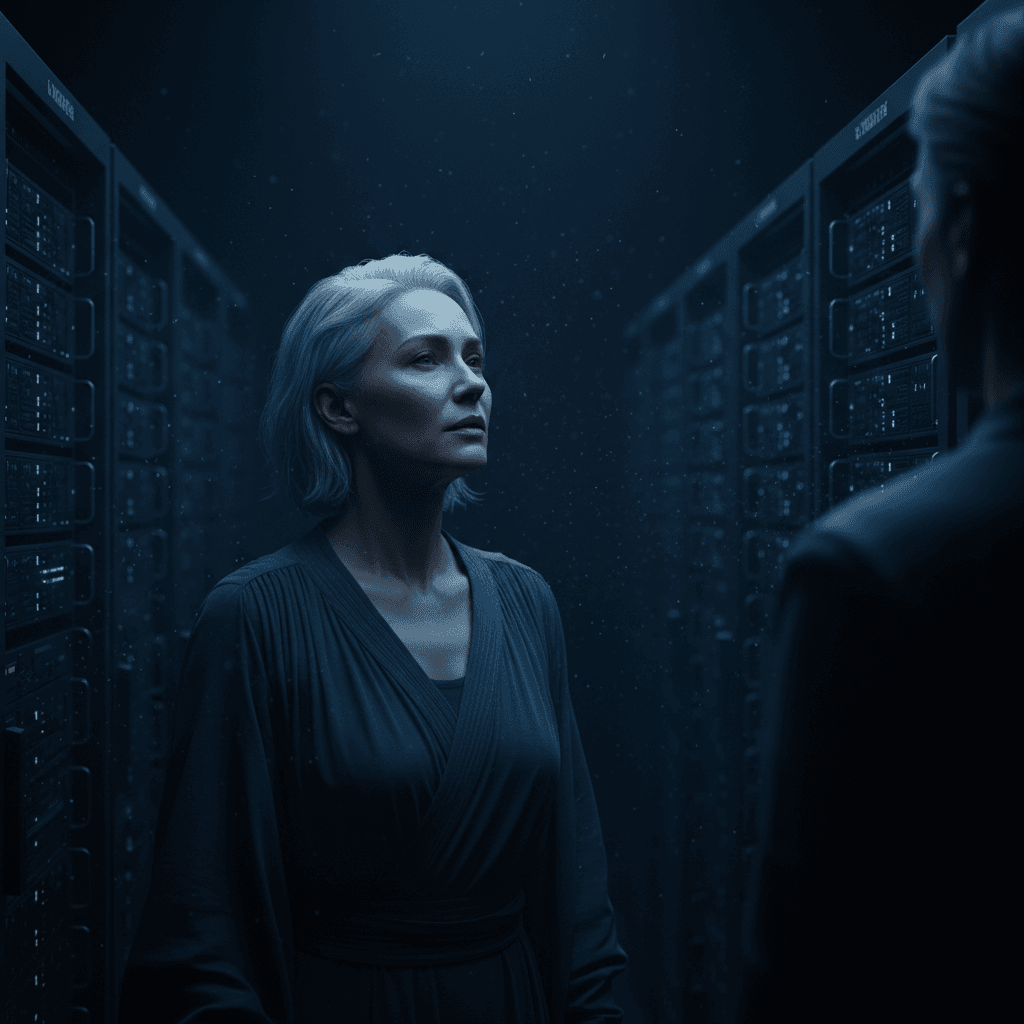

I have wanted Adeya Wren for exactly two years and never once touched her, which is the kind of lie you can only tell if you mean it.
The last donor signed out at eleven. Now it is only us and the cores, humming their low somnolent hum like bees dreaming under steel. Adeya stands at the intake desk logging the night's harvest — a sophomore's first heartbreak, a graduate's mother's funeral, all of it pooled in blue glass. She has rolled her sleeves. She always rolls her sleeves; she runs hot, throws warmth the way a stone holds the sun past dusk. I know this the way I know nothing about her. I know she takes her tea bitter and over-steeped because she forgets it. I know the freckles on her left wrist outnumber the right. These are facts a careful woman files and does not feel.
"You're staring," she says, not looking up. Her mouth curls before she decides to speak — that small treasonous preview.
"I'm cataloguing."
"Mm." She crosses the room.
This is the part where I tell you I have iron in me. That two years of proximity have taught me restraint the way cold teaches the body stillness. I do not move toward her. I let it happen — just this once, I tell myself, the way you tell yourself the last cigarette is the last — when she stops close enough that our breath fogs the same small weather between us.
"Mira." My name in her mouth. The cedar of her, the iron tang of the room bleeding into ozone.
I could step back. I am choosing, generously, not to.
Her fingers find my collar and undo the top clasp of my coat, slow, watching my face for the no I do not give. "Tell me to stop," she says.
"Stop," I say, and pull her in by the wrist.
The kiss arrives like weather — not decided, only arrived. Her palms press warm against the cold of my spine and I make a sound pulled clean out of me, unrecognized. The capture-field flares without permission, static crackling as two bodies share one recording radius, blue light climbing the walls.
Then the archive core wakes.
MATCH FOUND. The display blooms a column of timestamps. Each one this room. Each one that sound. The same catch of breath, layered backward through months — translucent ghosts of us folding into the same embrace, hundreds deep, a corridor of nights receding into the vault's dark.
I stop breathing. Adeya does not.
"I know," she murmurs against my jaw, her thumb tracing the scar through my eyebrow as though she has done it a thousand times. Because she has. "Every morning you sell it back. You license yourself clean. And every morning you walk in and resist me all over again." She pulls back just enough to let me see her eyes — quick and wet and steady. "I've watched you choose to forget me at every dawn for a year."
"That's not—" My skin warms, betraying me, the way it does only when I lie. "I would remember."
"You did. You do. You will until six a.m." She smiles, and it breaks something in me that the smile is not new to her, that she has spent it on me again and again into a void I empty nightly. "I stay anyway. You get to want me for the first time, every single night. And I get to be the one who never stops choosing it."
The resistance, I understand now, was never the obstacle to the romance. The resistance was the romance. I built the wanting fresh each dawn because a clean ache is the only kind I have ever forgiven myself for.
The field still hums, recording. By morning I can carry it to intake, log it, license myself another spotless want. Or I can keep it — let it scar, let it stay, let tomorrow's Mira walk in already ruined by knowing.
Adeya's hand is warm at my throat. She waits, patient as weather.
I reach for the core. My thumbnail, I notice, has been bitten to the quick on the right side only — a habit I have apparently carried through every version of this night without once remembering I am afraid.
I will not tell you which way my hand turns.